Faceless YouTube Automation: The Actual 2026 Workflow
Most "faceless automation" guides automate the wrong part, then quietly kill the channel. Here's the 6-stage workflow — and the two things you should never hand off to AI.
Channels that try to automate everything hit a wall inside a month — not because the AI can't write the script, but because operators automate the wrong 20% of the pipeline and the algorithm punishes the pattern. If you have not picked a niche yet, start with our breakdown of faceless YouTube channel ideas.
This is the exact playbook we have built FacelessGenie around — a single faceless video maker that handles every stage from script to publish — refined from watching operators run 3-10 channels at once without losing their minds. By the end you will have the 6-stage workflow, the 2026 tool stack, and the QC loop that keeps quality up as volume scales.
What "automation" is not
Three myths to bury before we get to the workflow:
- It is not "set and forget." Channels that auto-post 50 videos a month with no review die fast — the algorithm punishes pattern abuse.
- It is not "reupload other people's content with TTS over it." That worked briefly in 2021. It does not now.
- It is not a single tool. The operators who win run a stack — script, voice, visuals, captions, render, publish — and own the workflow between them.
Real faceless automation looks like this: you write one idea, the system produces one finished video, you spend 90 seconds reviewing the hook and thumbnail, and you publish. The full YouTube automation channel playbook in one workflow.
The real 6-stage workflow
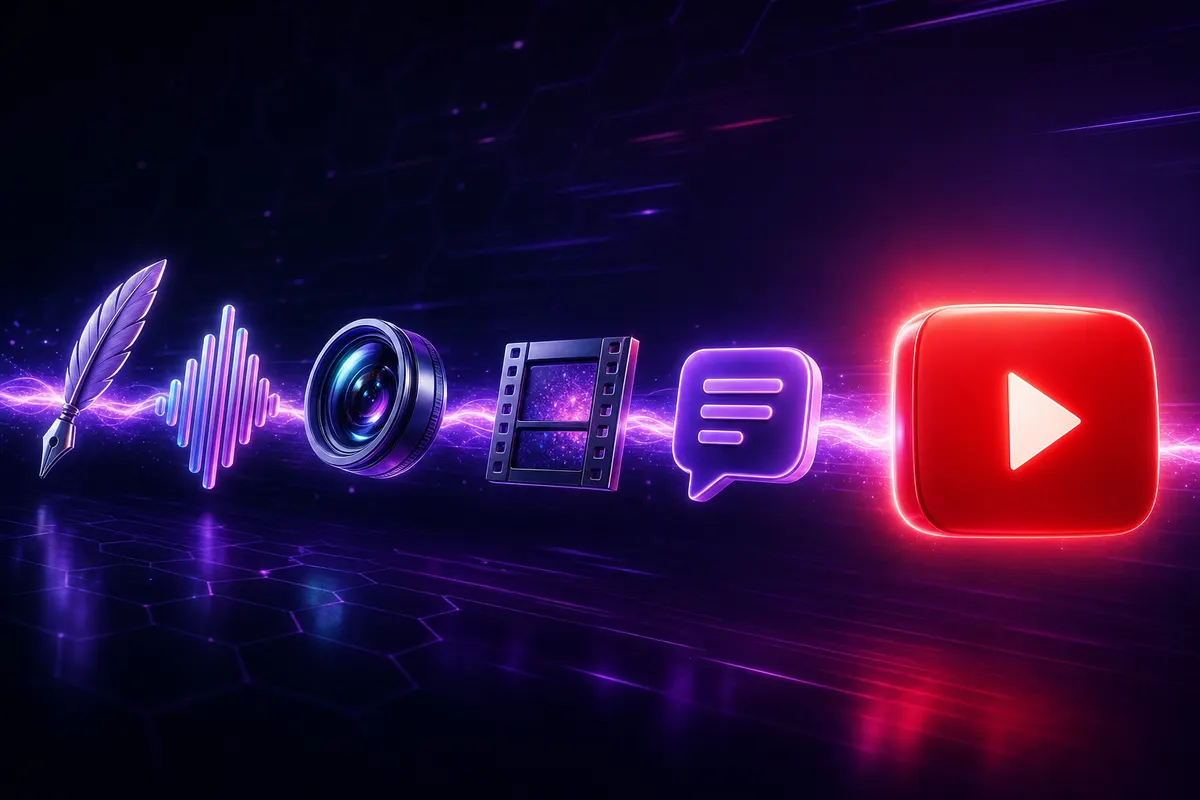
- 1Idea capture. Maintain a single doc with 100+ titles for your niche. Refill it once a week. Never start a video by staring at a blank page.
- 2Script generation. Use the best AI script generator you can afford. For Tier S niches in June 2026 that means Claude Opus 4.8 (Anthropic's most-honest model, shipped 28 May) or Gemini 3.1 Pro — Flash and Haiku models flatten the writing on longer scripts.
- 3Voice. Long-form gets the best AI voice generator tier (ElevenLabs v3 or MiniMax Speech-02). Shorts can run on Kokoro for cost.
- 4Visuals. Image-first for documentaries (FLUX 1.1 Pro or Seedream 4 → Seedance 2.0 or Kling 3.0 for cinematic clips). B-roll + still montage for daily news.
- 5Render + captions. Auto-burn captions, music ducked under narration at -22dB, thumbnail composited at render time.
- 6Publish. Cross-post via the YouTube API. Always with a final human glance at hook and thumbnail.
“If a step in your workflow needs a human five times in a row, automate it. If it needs a human once a quarter, leave it alone.”
The 2026 stack we actually use
There are 40 tools in this category. You do not need 40. Here is the lean, opinionated stack:
| Stage | Tool (June 2026) | Why |
|---|---|---|
| Script | Claude Opus 4.8 / Gemini 3.1 Pro | Honest, coherent long-form (Opus 4.8 shipped 28 May 2026) |
| Fast script | Gemini 3.5 Flash / Claude Sonnet 4.6 | Cheap daily-news writes at near-flagship quality |
| Voice | ElevenLabs v3 / MiniMax Speech-02 | Cleanest narration at speed |
| Image | FLUX 1.1 Pro / Nano Banana Pro / Seedream 4 | Cinematic stills for I2V |
| I2V clip | Seedance 2.0 / Kling 3.0 / Hailuo 2.3 | Best motion + style preservation under 10s |
| Budget I2V | Wan 2.6 Flash | ~$0.018/sec — scale runs without crying |
| Captions | Whisper Large v3 | Word-level timing |
| Render | Remotion on AWS Lambda | Fast, repeatable, scriptable |
| Publish | YouTube Data API v3 | Direct, no third-party scheduler tax |
Everything in this table is wired up inside FacelessGenie — you pick the model per stage and the credit system handles the rest. You can also rebuild it yourself if you like building plumbing.
Cadence and batching

The cadence trap: most new operators try to post daily for two weeks and burn out. The algorithm is forgiving on volume and brutal on inconsistency. Here is the rhythm that holds up:
- AI YouTube Shorts: 5-7 per week, posted at the same two times daily.
- Long-form: 2-3 per week, posted on fixed days (Tue/Thu/Sat works well).
- Batch in groups of 5-10. Same day, same style, same intro template.
- One full rest day per week. The algorithm noticed when channels run hot 24/7 — and a thread of evidence suggests it dampens reach.
Quality control loop
Automation without a QC loop becomes slop fast. The cheapest QC loop that actually works:
- 1Watch the first 15 seconds of every batch at 1x — that is the retention cliff.
- 2Re-score the hook against your last 5 best performers. If it does not beat any of them, regenerate.
- 3Check the thumbnail at the size YouTube actually serves it — 168x94 in the feed.
- 4Eyeball captions for word errors on niche-specific terms (names, places, jargon).
- 5Listen to one full minute of voice. AI voices drift on long takes; you catch it once a batch.
KPIs that matter
Most dashboards show you 40 numbers. You need five:
- Average view duration on long-form. Target 50%+.
- Average percentage viewed on Shorts. Target 70%+.
- Click-through rate (CTR). Target 6%+ for long-form, 8%+ for Shorts.
- RPM. Compare against the niche benchmark, not against random tweets.
- Subscriber-from-video rate. The cleanest signal of niche fit.
Frequently asked questions
Technically yes, but the channels that win in 2026 keep humans on hooks, thumbnails, and final review. "Full automation" channels exist, but most plateau quickly and many get caught by YouTube's repetitive-content policy.
Ship your first faceless video today.
Pick your niche. Pick your models. We render. From idea to finished short in under 7 minutes — no camera, no editor.