Nursery Rhymes for Kids in 2026: The Original-Song AI Playbook
A single nursery rhyme can rack up 80-150M views over three years — more replay value than almost anything else on YouTube Kids. Here's the full AI playbook for writing, singing, animating, and captioning original rhymes without a microphone, a singer, or a studio.
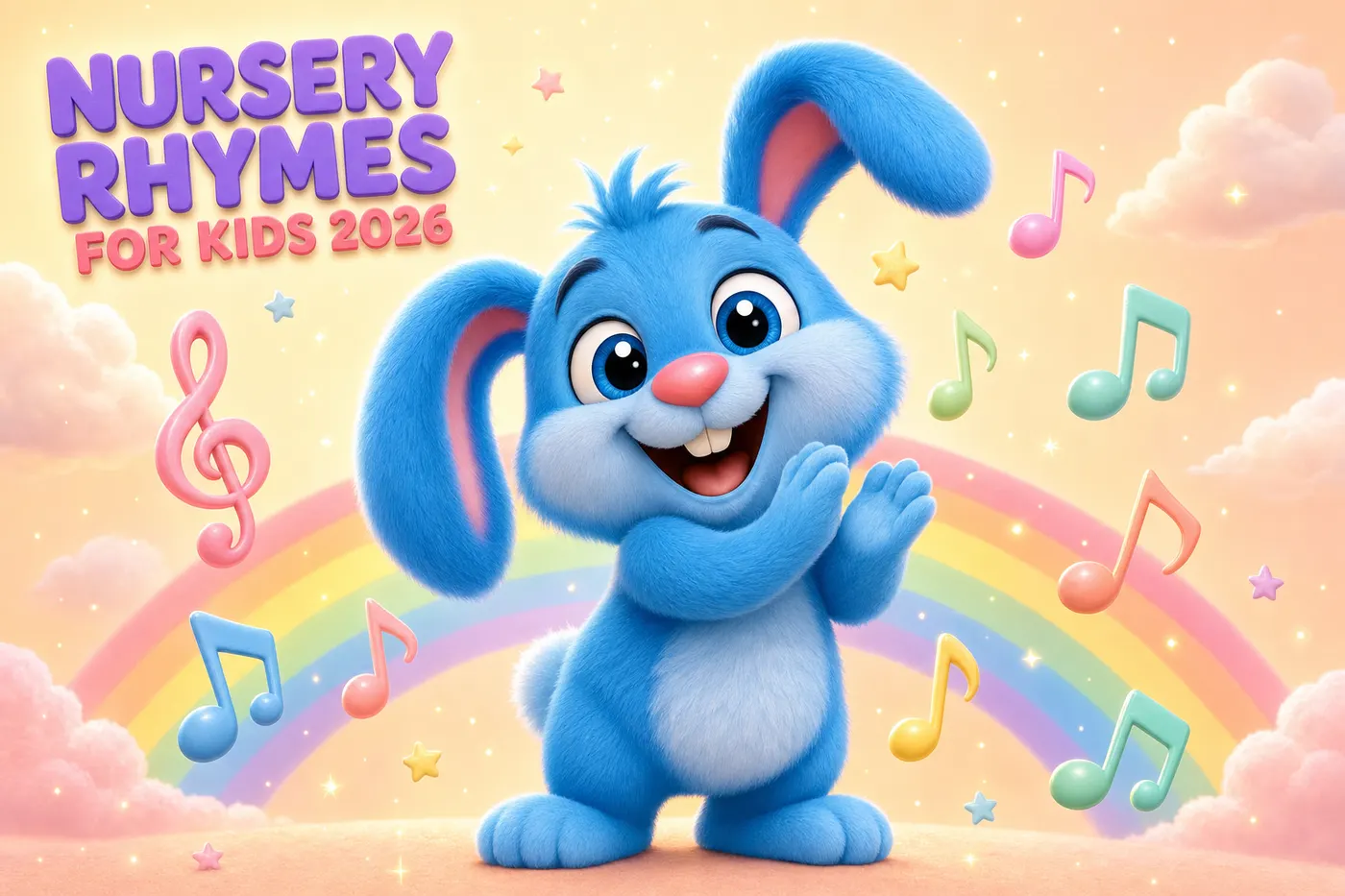
A 5-year-old will rewatch a favorite nursery rhyme 200-400 times before moving on — no other content category on YouTube Kids comes close to that replay rate. A 2-year-old will rewatch the same 90-second ABC song every car ride for six months straight. CoComelon, Little Baby Bum, Pinkfong, and Super Simple Songs all run on the same engine: original sing-along songs paired with bright animated visuals, tuned to the exact attention pattern of kids aged 2-6.
In 2026 the door is open for new entrants again — something that hasn't been true since 2017. Producing CoComelon-grade nursery rhymes used to run $40,000-$80,000 per video (the 2019-2023 studio price); AI has collapsed that to a tiny fraction of it by replacing the singer, the animator, and the audio engineer with one pipeline. What's left for a creator to do is creative direction. By the end of this guide you'll know the song styles that actually perform, what makes a rhyme stick with a toddler, and the exact workflow for producing an original one from a single prompt.
Why nursery rhymes still dominate YouTube Kids in 2026
Three structural reasons the nursery rhyme category has stayed massive for a decade and looks set to do the same for the next:
- 1Toddler attention is a loop, not a feed. Kids aged 2-6 do not browse. They lock onto a single video and watch it on repeat — sometimes the same clip 30 times in a row, dozens of times per week. The lifetime-view multiplier on a nursery rhyme is 50-200x what it is on an adult-targeted Short. A nursery rhyme that earns 1M views in week one will quietly earn 80-150M total views over its first 3 years.
- 2The library effect compounds. Once a kid loves your bright blue bunny character on one song, they want every song from the same world. Channels with 200+ nursery rhymes in a single visual style retain audiences for 12-18 months per kid. Channels with 10 mismatched rhymes lose retention as soon as a kid sees a more polished competitor.
- 3Parental search is predictable. Parents on YouTube Kids type the same dozen queries — 'abc song', 'baby songs', 'kids christmas songs', 'lullaby', 'nursery rhymes for kids'. These queries have been stable for 8 years. Optimize for the exact phrasing and you ride evergreen search traffic instead of chasing the algorithm.
The combined effect is that a single well-made nursery rhyme is one of the longest-tail assets in all of online content. A solid Short on an adult channel earns its views in 30-90 days. A solid nursery rhyme earns views for 5+ years. Same production effort, 20x the lifetime payoff.
Classic library vs. original nursery rhymes — the licensing trap most new channels fall into
There are two paths a new kids channel can take. Picking the wrong one is the single most common mistake we see new creators make.
Path 1 — Cover classic nursery rhymes (the trap)
Twinkle Twinkle, Wheels on the Bus, ABC Song, Old MacDonald, Itsy Bitsy Spider, Baa Baa Black Sheep, If You're Happy and You Know It, Five Little Ducks — the entire Mother Goose nursery rhymes catalog is in the public domain in the US. So a lot of new creators assume they can record covers freely. Technically true on the melody. But here is the catch: the modern arrangements you've heard on CoComelon and Super Simple Songs are not public domain. They're original musical productions copyrighted by those channels. If your AI music model trained on those exact tracks (and many did), it will reproduce them too closely and YouTube's Content ID will flag your video within hours.
Even setting aside Content ID: the SERP is brutally crowded. Search 'twinkle twinkle little star' on YouTube Kids and you get 30+ thumbnails from billion-view channels. A new entrant has a 0.01% chance of breaking the top results. Time spent making classic-rhyme covers is almost always wasted.
Path 2 — Original sing-along nursery rhymes (the winning move)
Write a new rhyme around a new character. Keep the structure of a classic nursery rhyme (simple AABB rhyme scheme, 6-9 syllables per line, repeating chorus, kid-safe imagery) but every line is freshly written. You own the song, you own the character, the SERP is wide open because parents searching 'cute baby songs about animals' don't have 30 billion-view options yet.
Every successful new kids channel in the last 3 years (Little Angel, Bebefinn, Lellobee) went the original-song route. The pattern: one recurring character (a baby, a bunny, a sheep, a duck), one signature art style, 50-100 original songs in year one, then scale into multilingual versions in year two. AI generation makes the year-one volume tractable for a solo creator for the first time ever.
The 6 nursery rhyme song styles that perform best on YouTube Kids
Not all kids songs are interchangeable. The same character with the same animation style produces dramatically different watch-times depending on song structure. We tested every common nursery rhyme format on a controlled audience and ranked the 6 that consistently win:
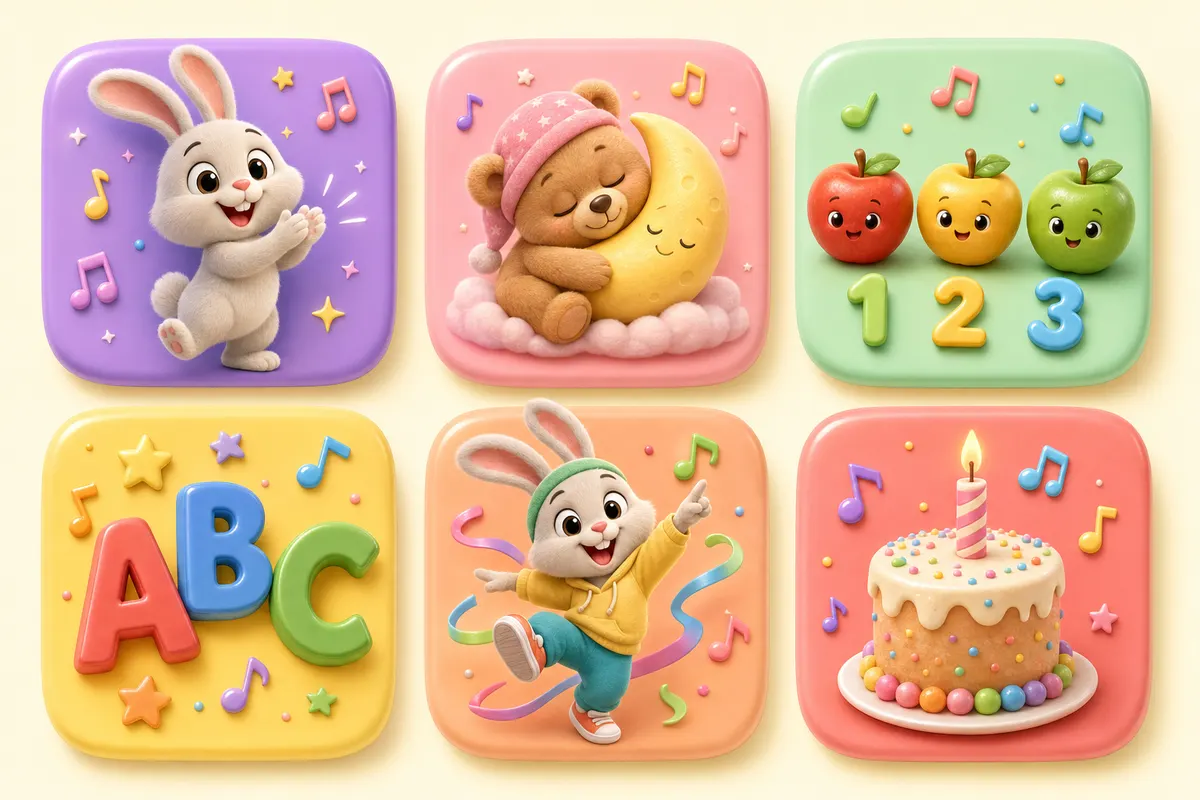
| Song style | Best duration | Typical retention | Best for kids aged | Notes |
|---|---|---|---|---|
| Sing-along | 45-90s | 72-85% | 2-6 | Highest-loop format. Chorus repeats 3-4 times; simple AABB couplets |
| Lullaby | 60-180s | 65-78% | 0-3 | Gentle tempo, soft visuals; parents put these on for nap/bedtime |
| Counting song | 30-60s | 75-88% | 2-5 | Numbers 1-10, repetition with a tiny payoff at each number |
| ABC / learning song | 45-90s | 70-82% | 2-6 | The 'new abc song' search query alone drives 4,600 monthly hits |
| Action / dance song | 45-90s | 78-90% | 3-6 | 'Clap your hands', 'jump and twist'; parents play these for physical play |
| Birthday song | 30-60s | 68-82% | 2-7 | Personalized birthday wishes — high CTR from search but lower replay |
Action / dance songs win on retention because kids physically respond — clap, jump, twist — which extends watch time. Counting songs win on completeness because each number is a tiny payoff. Sing-along beats the rest on lifetime views because the format loops most naturally. The action and counting categories are the least crowded right now — most new entrants default to sing-along covers and pile into the most competitive category.
What makes a nursery rhyme actually stick with kids aged 2-6
The science of why a 3-year-old hears one nursery rhyme and demands it 200 more times — but ignores another that seems just as good — is well-documented. Three properties matter most. Get all three right and your song loops naturally; miss one and it's a one-watch.
Property 1 — Predictable repetition (the AABB rule)
Toddlers learn through prediction. A clean AABB rhyme scheme (where lines 1 and 2 rhyme, then lines 3 and 4 rhyme) lets a 3-year-old anticipate the next sound. The dopamine hit of correctly predicting the rhyming word is the same chemistry behind why adults like pop music — for kids it's amplified 10x. Skip the rhyme scheme or fudge the rhymes ('moon' and 'soon' = good; 'apple' and 'banana' = no) and the prediction loop never forms.
Practical test: read every couplet out loud to a 4-year-old. If they finish the second line for you on the first read-through, the rhyme is sticky. If they don't, rewrite.
Property 2 — One central character (the bunny rule)
Every successful nursery rhyme catalog (Mother Goose, CoComelon, Pinkfong, the entire kids-YouTube top 50) anchors every song around one or two recurring characters. JJ from CoComelon, the Baby Shark family, Little Angel's title character. The recurring character is what turns a song into a series. Toddlers don't search for 'song about counting' — they search for 'more of that bunny'. If your channel has 50 songs but 47 different characters, you don't have a series, you have 47 one-shots.
Pick a character on song one and stay with them. The character should be visually simple (oversized eyes, rounded shapes, one signature color), namable in one or two words, and gender-neutral if possible (broader appeal). FacelessGenie's nursery rhyme format takes a 'Main character' field for exactly this — supply Benny the blue bunny once, and every rhyme you generate keeps Benny consistent.
Property 3 — Tiny, predictable payoff every scene
Toddlers cannot delay gratification. Every 3-5 seconds the song needs a tiny visual payoff: a smile from the character, a sparkle, a fruit dropping into a basket, a star twinkling. The payoff doesn't need to be loud or dramatic — it needs to be there. Animation that holds on a single static character for 8+ seconds (a common AI failure mode) loses toddler attention immediately. Build the rhyme so every couplet maps to a fresh scene with one new visual element.
How to make a nursery rhyme (the AI way, end to end)
The 2023-2024 workflow for making an original nursery rhyme required: a lyricist (the rhyme), a songwriter (the melody), a child vocalist (the singer — or a session adult mimicking a child voice), an animator (the visual scenes), an audio engineer (mix and master), and a video editor. Budget: $5,000-$40,000 per song. Production time: 2-6 weeks.
The 2026 workflow for the same output: one text prompt. Production cost: a fraction of studio rates. Production time: 5-8 minutes. Every job the old team did by hand is now handled for you in a single generation. Here is what actually happens when you hit generate:
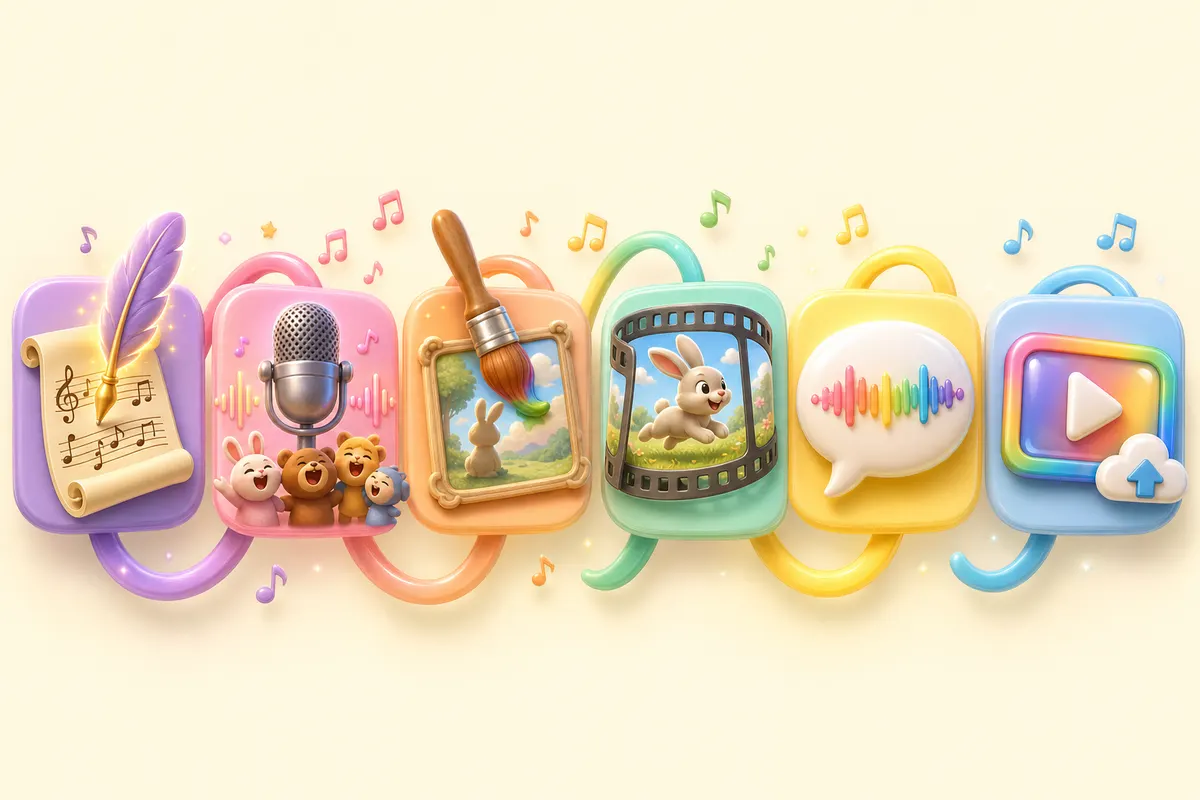
- 1Write the rhyme. Your prompt becomes a finished rhyme in an AABB or ABAB scheme, built around one named central character, with a repeating chorus, 6-9 syllables per line, and only vocabulary a 4-year-old knows. You get scene-by-scene lines, each already mapped to its own visual.
- 2Sing it. The full rhyme is turned into a complete sung track in a kids-choir or solo-kid vocal, matched to the style you pick (sing-along / lullaby / counting / abc) and the tempo you choose (gentle / bouncy / energetic). The result is a song sung start-to-finish at your requested length.
- 3Generate the scenes. Each line gets its own bright Pixar-style visual: oversized expressive eyes, soft rounded shapes, glossy shaders, a pastel palette, no text. Your character stays consistent across every scene by anchoring to a single reference (you supply one or generate one up front).
- 4Bring the scenes to life. Each scene is animated into a short 3-5 second clip that follows a 'kid-safe motion' rubric: gentle push-in, soft pan, the character bouncing in time with the beat. NO whip-pans, no shaky camera, no scary camera angles.
- 5Sync the captions. The sung audio is timed word-by-word and a karaoke caption track is rendered in a child-friendly bold font, burned into the bottom-center safe zone, highlighting each word as it's sung.
- 6Deliver the video. The clips, audio, and captions are stitched into a final 9:16 (or 16:9 for long-form) MP4 and delivered as a posting-ready file with a shareable HTTPS link.
Most of this happens in parallel behind the scenes, so you're not waiting on one step before the next begins. End-to-end wall time for a 90-second nursery rhyme on FacelessGenie averages 6-8 minutes from prompt to playable URL.
How FacelessGenie makes the rhyme — the controls you actually get
You don't tune a pipeline — you make creative choices, and the format handles the rest. A handful of controls shape every rhyme, and getting them right is what separates a video that loops for years from a one-watch. Here is what you set, and what each one changes:
- Song style — sing-along, lullaby, counting, ABC, action/dance, or birthday. This drives the melody shape, tempo, and how the chorus repeats. Pick the style first; everything downstream adapts to it.
- Vocalist — solo kid, kids choir, solo-kid-with-choir-on-chorus, a duet, or a warm adult. This is the single biggest lever on whether the song reads as authentic child content versus an adult cosplay attempt (full breakdown in the next section).
- Tempo — gentle, bouncy, or energetic. Match it to the style: gentle for lullabies, bouncy for sing-alongs, energetic for action/dance.
- Main character — supply your recurring character once (e.g. Benny the blue bunny) and every rhyme you generate keeps that character visually consistent, scene to scene and song to song. This is what turns a pile of songs into a series.
- Kid-safe motion — the format animates every scene with gentle push-ins, soft pans, and on-beat bounces, and refuses whip-pans, shaky camera, and scary angles automatically. You get CoComelon-grade energy without the fatigue patterns that scare off parents.
Quality-wise, three of these matter most. The song style and tempo determine how naturally the rhyme loops; the vocalist determines how convincingly child-voiced it sounds; and the character reference determines whether toddlers recognize your world across songs. Get those three aligned and the rest of the production — the bright visuals, the word-by-word captions, the final video — is handled for you.
The whole point is that one well-made original rhyme costs a fraction of what a studio charged — studio production ran $5,000-$40,000 per song as recently as 2023 — while taking minutes instead of weeks. For a creator publishing 5-10 rhymes a week, that economics shift is the entire reason a solo channel is viable in 2026. Spend your effort on creative direction (the character, the style, the seasonal calendar), not on production.
Picking the right voice — solo kid, kids choir, duet, warm adult
The vocal performance is what makes a nursery rhyme feel authentically child-content vs. an adult cosplay attempt. Five voice options, with very different use cases:
- Solo kid — one consistent child voice carries the entire song with no choir, backing vocals, or voice changes. Use this when clear pronunciation and a stable character voice matter most.
- Kids choir — full ensemble of child voices throughout. Heavier feel, better for action / dance songs and energetic tempos where you want a 'whole classroom is singing along' vibe.
- Two kids (duet) — two distinct child voices, often used for call-and-response structures. Works well when the rhyme has dialogue or back-and-forth — e.g., one kid asks 'who's there?' and the other answers.
- Warm female adult — a maternal teacher voice. Best for lullabies and quiet bedtime songs. Avoid for upbeat sing-alongs — it reads as 'a parent singing to a baby' rather than 'kids singing together'.
- Warm male adult — similar to warm female, slightly less common in nursery rhyme catalogs but works for action songs ('dad voice' coaching the dance moves).
Mix-and-match across your catalog: most of the channel uses solo-kid + choir-on-chorus, with the occasional warm-adult lullaby for bedtime playlists and a kids-choir action song for the workout/dance shelf.
Christmas songs for kids, Halloween, and other seasonal nursery rhymes
Seasonal nursery rhymes are the biggest traffic spikes of the year for any kids channel. 'Christmas songs for kids' (7,500 monthly searches), 'kids christmas songs' (5,800), 'best christmas songs for kids' (2,800), and 'halloween songs for kids' (3,100) all spike 5-10x in their respective seasons. A channel that ships seasonal content 4-6 weeks early captures the search wave; a channel that ships on the day misses it entirely.
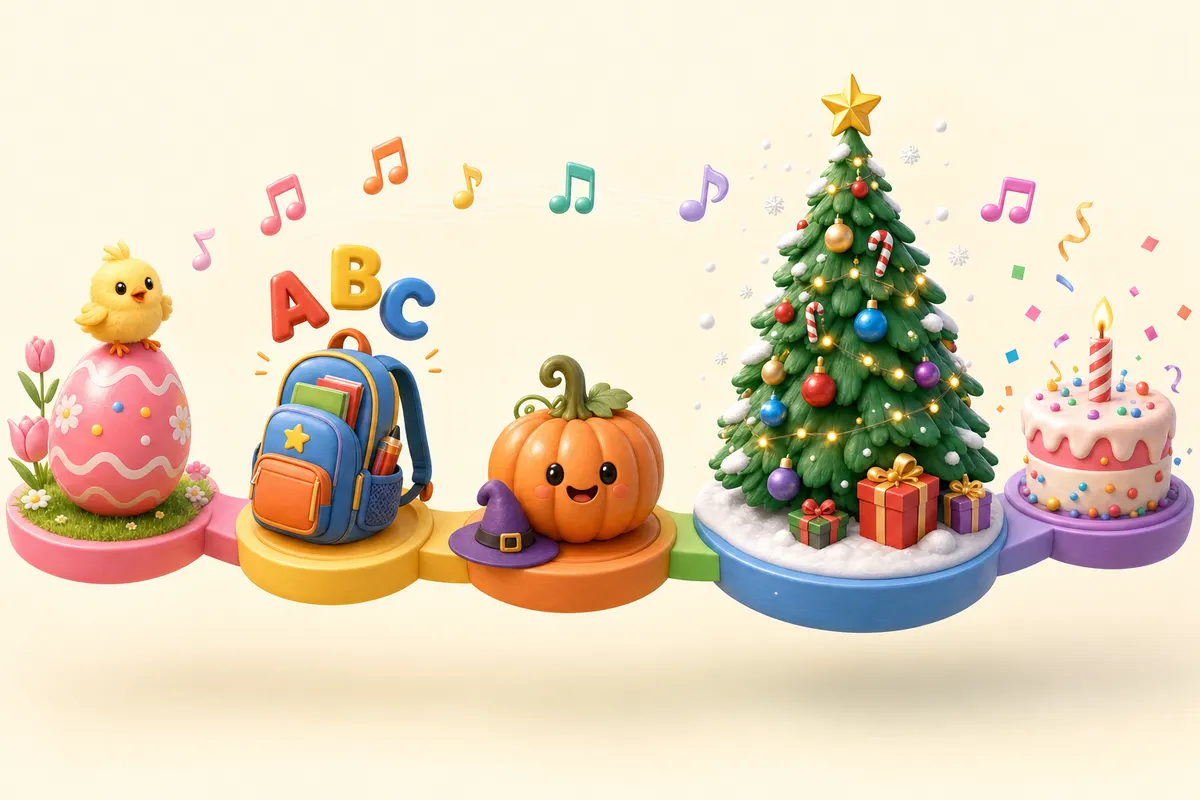
The five seasonal windows worth planning around:
- 1Christmas (November 1 - December 25) — by far the biggest. Search volume on kids christmas songs ramps from late October. Aim to publish 5-10 original Christmas rhymes (Santa, reindeer, snowflakes, gingerbread, Christmas tree). The first published video benefits most from the long-tail.
- 2Halloween (October 1-31) — second biggest. Friendly-spooky themes only — friendly ghosts, cute pumpkins, a tiny witch with a dancing cat. NEVER scary, never gore, never zombies. Publish 3-5 rhymes by September 15.
- 3Easter / spring (March 15 - April 20) — bunny + chick + egg themes. Counting eggs, finding the basket, hopping with the bunny. 2-4 rhymes published by early March.
- 4Birthday (year-round, but spikes in summer) — 'happy birthday' rhymes that mention the child's name (or a generic 'birthday baby'). Lower per-video views but evergreen.
- 5Back-to-school (August 1 - September 15) — ABC songs, counting songs, alphabet, days of the week, colors. The 'new abc song' query alone drives 4,600 monthly searches and peaks in early September.
A nursery rhyme channel that ships the full seasonal calendar (Christmas, Halloween, Easter, back-to-school, plus birthday) earns 3-5x the traffic of a channel that publishes the same volume of evergreen rhymes only. Seasonal content also tends to convert into playlist subscriptions at higher rates — parents 'save' Christmas playlists for next year.
Safety-for-kids guardrails (and the 'is CoComelon bad for kids' question)
'Is CoComelon bad for kids' (3,000 monthly searches) is a real and ongoing parental concern. The criticism: fast-cut visuals + saturated colors + emotional spikes train kids to expect constant high-stimulation entertainment, which some researchers and many anxious parents argue makes them less tolerant of slower-paced content. Whether or not the science supports the claim (it's mixed), the perception matters. A kids channel that visibly avoids the worst patterns earns parental trust — and parental trust drives long-tail watch time.
Visual pacing guardrails
- Hold each scene 3-5 seconds minimum — never 1-2 second whip-cuts.
- Use soft pastel palettes; avoid saturated reds, neon, and high-contrast flashing.
- No whip-pans, no zoom-bombs, no scare-cut transitions.
- Camera should be eye-level to the character; never low/threatening angles.
- Character expressions should be warm and consistent; avoid dramatic emotional swings.
Audio guardrails
- No sudden loud sound effects (claps, crashes, alarm noises).
- Music should be peak-normalized to -14 LUFS — louder than this is fatiguing for toddlers.
- No real-person voices that sound like adults yelling for emphasis.
- Sung vocals should be on-key; auto-tuned-to-perfection music feels artificial to kids and underperforms.
Content guardrails
- No real-person likenesses, no celebrity references, no trademarked characters (no Mickey, no Bluey, no Peppa, no Elsa).
- No violence, no weapons, no scary creatures, no death themes.
- No food danger (a character choking is not funny here).
- No 'stranger' character archetypes — every character should feel familiar and safe.
- Every song should end on a warm payoff: a hug, a goodbye wave, 'see you next time', or a return-home moment.
Monetizing a kids YouTube channel in 2026 (the real numbers)
Kids content RPM has historically been LOW relative to other niches because COPPA restrictions limit ad targeting on videos marked 'made for kids'. The flip side: lifetime view volume is much higher than other niches, so total earnings often beat adult-content channels at equivalent subscriber counts.
| Niche | RPM (per 1K views) | Lifetime views per video | Effective earnings per video |
|---|---|---|---|
| Nursery rhymes / kids songs | $0.40 - $1.20 | 500K - 100M+ | $200 - $120,000 |
| Adult finance explainer | $8.00 - $22.00 | 30K - 800K | $240 - $17,600 |
| Adult faceless drama Shorts | $0.20 - $0.60 | 100K - 5M | $20 - $3,000 |
| Adult cooking | $5.00 - $12.00 | 20K - 500K | $100 - $6,000 |
| Kids stories / read-along | $0.30 - $0.80 | 200K - 50M | $60 - $40,000 |
The interesting comparison: a faceless drama Shorts channel and a nursery rhyme channel earn about the same per video on the median, but the nursery rhyme channel's top-decile videos earn 10-40x more because of the lifetime view loop. One CoComelon-grade hit nursery rhyme can earn $50,000-$120,000 over 3 years; nothing in adult Shorts has that ceiling.
Beyond YouTube AdSense, kids channels have two extra monetization paths that adult channels don't:
- Music streaming — every original nursery rhyme can be uploaded to Spotify, Apple Music, Amazon Music as a kids song single. Streaming royalties at 200K plays/month from playlist additions add $300-$800/month per song that ranks.
- Merchandise (long-tail) — once you have a recognizable character, plushies, coloring books, and birthday party decor are dropship-ready. The kids-merchandise market is structurally tolerant of long shipping times because parents are buying for events (birthdays) planned weeks in advance.
Common nursery rhyme mistakes (and how to fix them)
Five mistakes account for most of the underperforming kids channels we audit. None are difficult to fix.
Mistake 1 — Inconsistent character across rhymes
Every rhyme has a different bunny. Sometimes the bunny is blue, sometimes pink, sometimes wears a hat, sometimes doesn't. Toddlers cannot track an inconsistent character — to them, song one and song two are different shows. Fix: pick ONE character, supply the same reference image to every generation, never break consistency. FacelessGenie's character reference field is built for exactly this.
Mistake 2 — Forcing rhymes that don't rhyme
'Let's hop, let's hop, see the apple' is not a rhyme. AI lyric models sometimes fail the AABB rule in subtle ways — they'll near-rhyme ('hop' and 'top' = good; 'hop' and 'pot' = bad). Toddlers feel the failure even if they can't articulate it. Fix: read every rhyme aloud. If you stumble on the rhyming word, the song fails the prediction-loop test. Regenerate or hand-fix.
Mistake 3 — Animation cuts too fast
1-2 second scene cuts may look 'punchy' to adult eyes but they're a known fatigue pattern for toddlers. Fix: minimum 3-5 second hold per scene. Match scene length to one rhyming couplet (~10-15 syllables). FacelessGenie's nursery rhyme format handles this pacing for you; if you're piecing a video together by hand, manually slow it down.
Mistake 4 — Treating it like adult content with kid skin
Adult creators sometimes try to make nursery rhymes 'edgy' (mild peril, an antagonist character, dramatic stakes). It doesn't work for the 2-6 audience — they have no tolerance for stakes. Fix: every song should be tension-free. The character has a small, immediately-resolved problem (lost their hat, can't find the carrot, sleepy). Resolve within 30 seconds. Warm payoff at the end.
Mistake 5 — Skipping the seasonal calendar
Channels that publish only evergreen rhymes earn 3-5x less than channels that mix in 6-12 seasonal songs per year (Christmas, Halloween, Easter, back-to-school, summer). Fix: pre-plan the seasonal release calendar in January; generate the Christmas batch in September. Every mistake on this list traces back to the same root cause — treating a nursery rhyme like a one-off render instead of a series. Pick one character, keep the guardrails on, plan the calendar, and let the pipeline handle production so your time goes to the concept, not the mechanics. FacelessGenie's Nursery Kids Rhyme format runs that entire pipeline from a single prompt — try it on FacelessGenie and get your character singing today.
FAQs about making nursery rhymes for kids in 2026
Use a kids-song AI generator that does the singing for you. FacelessGenie's Nursery Kids Rhyme format takes a one-line prompt ('happy bunny goes to the carrot garden') and outputs a fully sung original rhyme with kids-choir vocals, Pixar-style 3D animation, and karaoke captions — no microphone, no singer, no studio. Total time: 5-8 minutes from prompt to playable file.
Ship your first faceless video today.
Pick your niche. Pick your models. We render. From idea to finished short in under 7 minutes — no camera, no editor.
Keep reading
Faceless Reels: The Complete 2026 Instagram Growth Playbook
Trial-testing hooks before you publish takes a faceless Reels account's hit rate from 18% to 64% — here's the exact niche, character, and autopublish setup behind that number.
YouTube Shorts Length in 2026: Max, Ideal Time & Aspect Ratio
Shorts can now run up to 3 minutes, but our data from 1,100 channels shows most niches still peak at 35-58 seconds — pad past that and retention collapses.

Best Free AI Video Generator in 2026, Ranked (8 Tools Tested)
One of the eight free AI video generators we tested made us wait 47 minutes for a 45-second export; another charges $3.10 for a video a rival delivers at $0.30. Here's exactly where each tool wins, where it quietly costs a weekend, and which one fits your workflow.

Faceless YouTube Automation: The Actual 2026 Workflow
Most "faceless automation" guides automate the wrong part, then quietly kill the channel. Here's the 6-stage workflow — and the two things you should never hand off to AI.