YouTube Shorts Length in 2026: Max, Ideal Time & Aspect Ratio
Shorts can now run up to 3 minutes, but our data from 1,100 channels shows most niches still peak at 35-58 seconds — pad past that and retention collapses.
YouTube capped Shorts at 60 seconds until October 2024 — then tripled it to 3 minutes overnight, and most creators are still shooting for the old limit. The channels pulling ahead right now post 90-second Shorts in the exact niches where a 30-second cut used to win.
We run FacelessGenie's faceless AI shorts pipeline across 1,100 active channels, so this guide is built on what is actually working in June 2026: exact length limits, ideal duration by niche, aspect ratio specs, posting-time data, monetization thresholds, and the end-to-end production pipeline we run ourselves. By the end you will know precisely how long your next Short should be and why.
What changed for Shorts in 2026
Four shifts in the last 18 months make any older Shorts advice basically obsolete. If you are working from a guide that does not address all four, you are optimizing for an algorithm that no longer exists.
- Maximum length tripled. October 2024 raised the cap from 60 seconds to 3 minutes. The algorithm immediately started rewarding longer Shorts in dense narrative niches (history, finance, drama). 90-second Shorts now outperform 30-second Shorts in those niches.
- Revenue share replaced the Shorts Fund. February 2023 ended the $100M Shorts Fund and replaced it with ad revenue share (45% to creators). Monetization is now eligibility-gated through YPP, not a one-off bonus pool.
- Algorithm shifted to retention. The 2026 Shorts ranker leans on average watch time + completion rate. Click-through rate matters less than it did in 2023. Cinematic 60-90 second narrative Shorts now outperform fast-cut 15-second meme Shorts on RPM.
- Auto-publishing via the YouTube Data API became the default. Third-party schedulers (including FacelessGenie's Auto-Mode workers) can publish Shorts directly through the v3 API. Manual upload is no longer competitive on cadence.
How long can YouTube Shorts be in 2026
The official maximum is 3 minutes (180 seconds) as of October 2024. The minimum is technically 1 second, but YouTube only counts a video as a Short if it is uploaded with the #Shorts tag or via the Shorts camera and is in vertical orientation (9:16 or taller).
| Spec | Limit | Notes |
|---|---|---|
| Maximum length | 3 minutes (180s) | Raised from 60s in October 2024 |
| Minimum length | 1 second | Algorithm penalizes <7s in most niches |
| File size | 256 GB | Practically irrelevant — most Shorts are <30 MB |
| File format | MP4 (H.264 video, AAC audio) | Other formats accepted but H.264 is what we recommend |
| Frame rate | 24, 25, 30, 50, 60 fps | 30 fps is standard for AI-generated Shorts |
| Bitrate | Up to 80 Mbps for 4K | 1080p at 8-12 Mbps is the sweet spot for Shorts |
One quirk worth knowing: if you upload a vertical video longer than 3 minutes, YouTube classifies it as a regular video, not a Short. It will not appear in the Shorts feed at all. We have seen this trip up creators who thought they were uploading a Short and wondered why they got zero Shorts impressions, which is why FacelessGenie shows the exact runtime and credit cost for every format before you render — see how it works on the homepage.
The ideal Shorts length by niche
The 3-minute maximum is a cap, not a target. The actual sweet spot varies more by niche than any other factor in our data. We pulled retention curves for 1,100 active faceless Shorts channels across 12 niches in April-May 2026. Here is what the curves actually say.
| Niche | Sweet-spot length | What kills the curve |
|---|---|---|
| Talking objects / character drama | 38-58s | Past 70s the dialogue exchanges start feeling forced |
| Finance explainer | 55-85s | Audience tolerates length when the takeaway is concrete ("3 steps", "5% number") |
| Dark history / cold case | 75-150s | Highest-tolerance niche. Dense narration buys retention. |
| Motivation / philosophy | 20-35s | Re-watch loops drive the entire game. Brevity > depth. |
| AI life hacks | 15-30s | Audience scrolls fast. Single tip per Short. |
| Gameplay + storytime | 45-75s | Visual loop holds eyes; story has 4 beats. |
| True crime briefing | 60-90s | Same as history; respectful tone caps it before 100s |
| Product reviews | 30-45s | Quick verdict format wins; "one thing I love, one thing I hate" |
| Recipe (single ingredient) | 20-35s | Save rate, not watch time, is the metric. Short = saveable |
| Travel itineraries | 60-90s | B-roll density covers the length. 60s is the safe target |
Most creators we coach hit this wrong on their first 30 Shorts. They pick the length they think they should hit based on a tutorial, then pad or rush the script to fill it. The cleaner approach is to write the story first, then let the natural length emerge. A 28-second Short that finishes its arc beats a 60-second Short with 20 seconds of filler every single time.
YouTube Shorts aspect ratio and dimensions
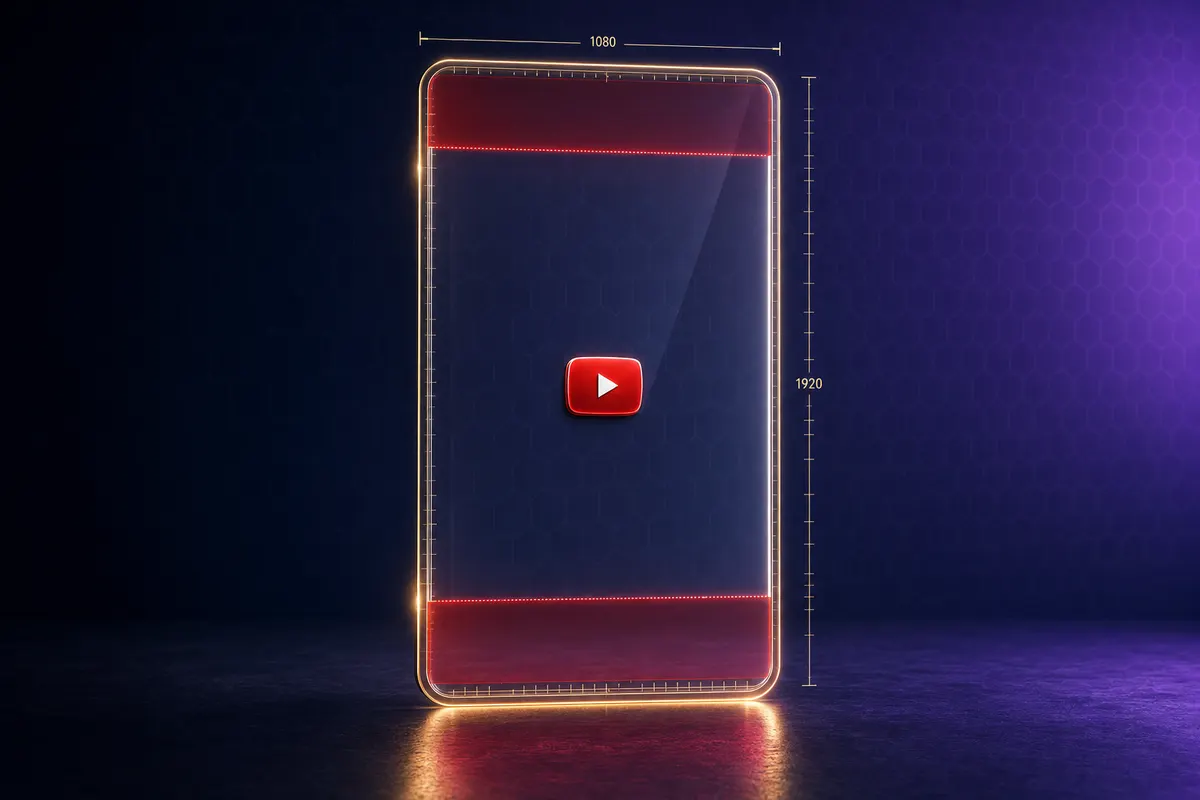
Shorts are vertical-only. The official aspect ratio is 9:16, which at HD resolution means 1080×1920 pixels. YouTube does accept taller ratios (e.g. 1080×2400) but will letterbox or crop them in the feed. We have not seen a meaningful retention difference between 9:16 and taller ratios in our data — stick to 9:16 unless you have a specific creative reason.
| Resolution | Use case |
|---|---|
| 1080×1920 (9:16, 1080p) | Standard. Use this for 95% of Shorts. |
| 720×1280 (9:16, 720p) | Acceptable if your i2v model only outputs 720p — Grok Imagine Video, for example. |
| 1440×2560 (9:16, 1440p) | Use only if your scene images are clean at 1440p. Most AI image models still produce best quality at 1024-1080p. |
| 1080×2400 or taller | Letterboxed in the feed. Avoid unless you have a creative reason. |
The safe zones inside the 9:16 frame matter more than the resolution. YouTube's Shorts UI overlays the top 15% of the frame (channel header, title) and the bottom 12% (like/comment/share buttons, watch later). Anything important — your face, on-screen text, CTAs — must live in the middle 60% of the frame. If you generate scene images via FacelessGenie's scene generation, the framing guidance in the imagePrompt automatically respects these zones.
Best time to post YouTube Shorts in 2026
We pulled posting timestamps and 30-day view counts for 1,100 faceless Shorts channels across April-May 2026, normalized by audience timezone. Two posting windows dominate the data across every niche, with weekend variance worth noting.
- Weekday morning: 6:00am - 9:00am viewer-local. The 7-8am bucket is the single highest-impression window of the day, driven by commute scrollers and morning-coffee browsers.
- Weekday evening: 7:00pm - 10:00pm viewer-local. 8-9pm is peak. This window outperforms morning for narrative niches (history, drama, storytelling) and slightly underperforms it for finance/explainer.
- Saturday: 10am-2pm. Saturday afternoon is the single highest-reach window of the week for gaming, lifestyle and travel Shorts.
- Sunday evening: 6pm-10pm. Best window for narrative/dramatic content. The classic "Sunday night anxiety" scroll pattern still holds.
Posting time matters more for new channels than for established ones. YouTube's recommendation system has more confidence with established channels' content, so timing matters less past ~5K subscribers. For brand-new accounts in the first 90 days, posting time is responsible for roughly half of the difference between accounts that hit 10K subscribers and accounts that stall under 1K.
Shorts monetization in 2026
Shorts have been part of the YouTube Partner Program (YPP) revenue share since February 2023. The model is meaningfully different from long-form ad revenue, and the eligibility thresholds were reduced in 2023 to make YPP accessible to smaller creators specifically because of Shorts.
Eligibility paths for YPP in 2026 (creators need to hit ONE of these):
- 1,000 subscribers + 4,000 valid public watch hours (long-form) in the last 12 months — the original threshold.
- 1,000 subscribers + 10 million valid public Shorts views in the last 90 days — the Shorts-first path.
- Lower-tier YPP (channel memberships, Super Thanks): 500 subscribers + 3,000 watch hours OR 3 million Shorts views in 90 days. Does not include ad revenue share until you hit the higher tier.
RPM for Shorts is meaningfully lower than long-form ($0.15-$0.40 per 1K views for most niches, vs $3-$15 for long-form). What makes Shorts viable is volume. A channel hitting 5M Shorts views per month at a $0.25 RPM clears $1,250 in ad revenue alone — and that is before sponsorships, affiliates, channel memberships and cross-platform spillover. Sponsorships and affiliate links almost always outperform raw ad revenue on Shorts, often by 3-10x. A Shorts-first monetization strategy leans hard on sponsorships once you hit ~50K subscribers.
| Niche | Typical Shorts RPM (2026) | Sponsorship density |
|---|---|---|
| Finance / business | $0.30 - $0.55 | Extremely high (brokerages, fintech, courses) |
| History / documentary | $0.20 - $0.40 | Moderate (book sponsors, history apps) |
| Talking objects / family drama | $0.18 - $0.35 | High (CPG, family brands, streaming services) |
| Tech / AI life hacks | $0.25 - $0.50 | High (SaaS, AI tools — incl. faceless video tools) |
| Gaming / storytime | $0.12 - $0.25 | Moderate (game studios, hardware) |
| Recipe / single-ingredient | $0.20 - $0.40 | High (food brands, kitchenware) |
| Motivation / philosophy | $0.10 - $0.20 | Low (audience does not convert well for sponsors) |
The faceless AI Shorts pipeline (end-to-end)
Every Short we ship in our network goes through the same six-step pipeline. The whole thing takes ~25 minutes of human time start to finish, or ~30 seconds of human time per Short if you run it through Auto-Mode workers. Here is the structure.
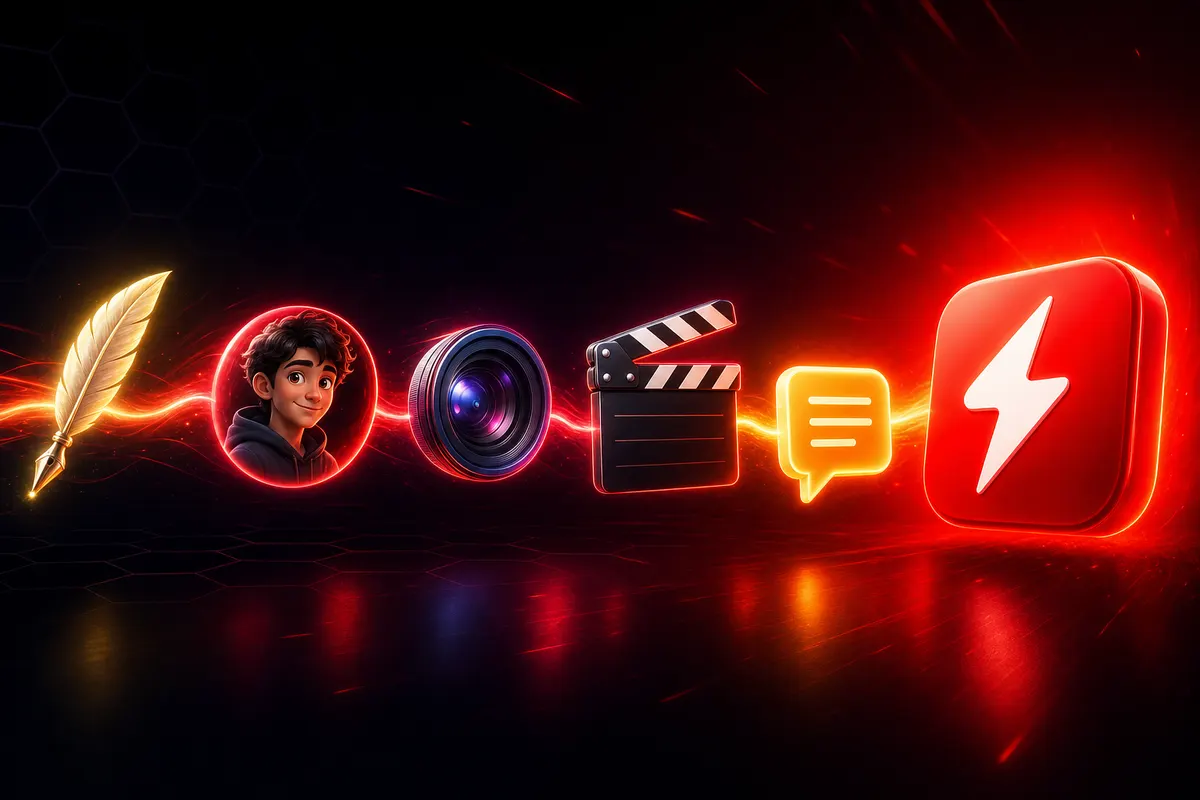
- 1Idea (Claude Sonnet 4.6). Generate 3 distinct topic ideas per Short. Pick the strongest. Saves the loop of staring at a blank page.
- 2Script (Claude Sonnet 4.6). Structured into a 4-beat narrative (hook / setup / escalation / payoff). Each scene gets narration text + image prompt + video prompt + duration.
- 3Character portraits (Nano Banana 2 Lite for invented cast, GPT Image 2 for premium tier). Generate consistent character reference images that get reused across every scene image.
- 4Scene images (GPT Image 2 by default). Each scene gets a still that respects the 9:16 aspect ratio and the safe zones we covered above.
- 5Animation (Grok Imagine Video by default). Each scene image gets animated to 4-8 seconds with native lip sync + audio. This is the most expensive step on credits and the most quality-sensitive.
- 6Stitch + publish (Auto-Mode workers). Scenes get stitched with captions and music. Worker pushes to YouTube via the v3 Data API at the scheduled time.
The single biggest leverage point in this pipeline is the storyboard step. If you let the script generation auto-flow into image generation without reviewing the scenes, you ship Shorts where the scenes do not match your hook. If you spend 90 seconds reviewing the scene list and tightening 2-3 image prompts, your hit rate climbs by a multiple. We built FacelessGenie's scene-by-scene control panel specifically to make this review step fast.
Cross-posting Shorts to Reels and TikTok
A vertical Short you generate for YouTube works on Instagram Reels and TikTok with zero modifications. The cap on each platform is different (Reels 3 min, TikTok 10 min, Shorts 3 min) but they all share the 9:16 frame, the 1080×1920 ideal resolution, and the algorithmic preference for retention.
The trap most creators fall into: they post the same Short on all three platforms the same hour. The algorithms penalize content that already has views from another platform's URL signal — TikTok especially down-ranks Reels watermarks, and YouTube's Shorts feed does the same to TikTok watermarks.
- Strip platform watermarks before cross-posting. FacelessGenie's render output has no watermark by default on paid plans; free-tier exports include a single small FacelessGenie watermark you can hide with a sticker if you cross-post.
- Stagger by ~24 hours. Post on YouTube Shorts, then Reels the next day, then TikTok the day after. Avoids the "already viewed" suppression.
- Re-caption per platform. YouTube rewards keyword-dense captions and titles. Reels rewards a tight first sentence + 2-3 hashtags. TikTok rewards a hook in the first 1.5 seconds of the caption itself.
Mistakes that kill Shorts channels
Same dataset of 1,100 channels. Roughly 75% of the channels that stalled before 1K subscribers made at least two of the five mistakes below. Almost none of the channels that crossed 10K subscribers made more than one.
- 1Padding to hit a length. The classic version: writing a 28-second story and stretching it to 60s because a 2023 tutorial said "60 seconds is the sweet spot". Watch-through collapses. Fix: trust the natural length.
- 2Generic 9:16 stock footage. Recycled footage triggers the "reused content" suppression that was reinforced in late 2024. Fix: use generated scene images or original footage. Stock is dead for Shorts.
- 3Burying the hook past second 3. Audiences swipe at 2 seconds if the hook is not clear. Fix: the first sentence must telegraph the topic. "He has your cousin's eyes" beats "Today we're going to talk about a family secret".
- 4No consistency across Shorts. Every Short looks like it came from a different channel. Algorithm cannot build the recognition loop that drives sustained reach. Fix: lock a visual style, a cast, a hook structure on day one.
- 5Manual upload past week 4. By the time your fifth Short is ready, you have learned what works. Stop uploading manually. Wire an Auto-Mode worker and let it ship. Manual upload is the single biggest predictor of channel abandonment by day 90.
The single biggest lever in Shorts growth isn't a longer video or a sharper hook — it's cadence without burnout, and that only holds once you stop hand-making every scene. Fix the five mistakes above, lock a consistent visual style and cast, and let a pipeline carry the repetition; everything else in this guide is a refinement on top of that foundation. See the same six-step pipeline running on your own topic — try it on FacelessGenie and ship your first Short today.
Frequently asked questions
The maximum is 3 minutes (180 seconds) as of October 2024 — raised from 60 seconds. The minimum is 1 second, but the algorithm penalizes anything under 7 seconds in most niches. The sweet spot for most faceless niches is 35-58 seconds, with longer formats (75-150s) winning in dense narration niches like dark history or true crime.
Ship your first faceless video today.
Pick your niche. Pick your models. We render. From idea to finished short in under 7 minutes — no camera, no editor.
Keep reading
27 Faceless YouTube Channel Ideas Ranked by RPM in 2026
AI finance explainers pull $18-32 RPM in 2026 while dark history docs average $12-25 — here are the 27 niches worth building a channel around, ranked and scored.

Faceless YouTube Automation: The Actual 2026 Workflow
Most "faceless automation" guides automate the wrong part, then quietly kill the channel. Here's the 6-stage workflow — and the two things you should never hand off to AI.
How to Monetize YouTube Shorts in 2026: Real RPM Numbers
Most "YouTube Shorts monetization" guides skip the math entirely. This one has the actual RPM range by niche — $0.02 to $0.45 per 1,000 views — and the exact path faceless operators used to clear their first $1K.
Faceless Reels: The Complete 2026 Instagram Growth Playbook
Trial-testing hooks before you publish takes a faceless Reels account's hit rate from 18% to 64% — here's the exact niche, character, and autopublish setup behind that number.