AI Documentary Generator: Make a Faceless Documentary in 2026
AI can shorten the slow parts of documentary production, but it cannot decide what is true or what matters. This practical guide shows how to turn a researched question into a clear script, purposeful scenes, natural narration, and an original video viewers can trust.
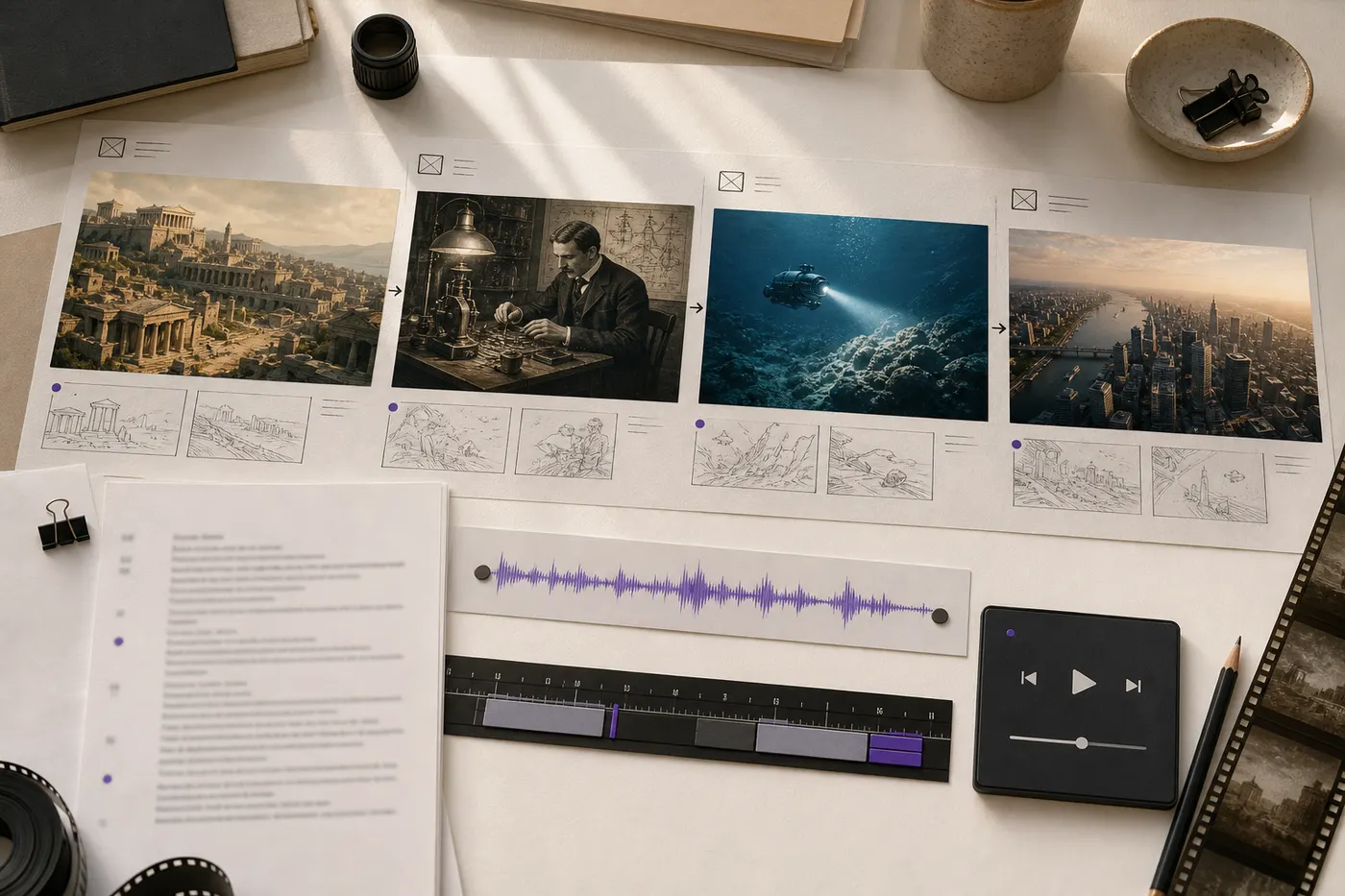
A good documentary does not begin with a dramatic voice. It begins with a question. Why did a successful company disappear? How did one engineering choice change a city? What really happened during a forgotten expedition? The job of the filmmaker is to follow that question, test the easy answers, and arrange the evidence into a story a viewer can understand.
An AI documentary generator can make that process much faster. It can help turn research notes into an outline, shape narration, plan scenes, create original supporting visuals, produce a voiceover, add music and captions, and render the final video. A creator who once needed several disconnected tools can now build a complete faceless documentary from one production flow.
The speed is useful, but it creates a new risk. A polished video can look authoritative even when the research is weak, the images imply events that never happened, or the script repeats the same shallow facts found on every other channel. The solution is not to avoid AI. It is to give AI a narrower job and keep the important editorial decisions in human hands.
What is an AI documentary generator?
An AI documentary generator is a video production system that helps create a factual, narrator-led video from a topic, brief, source, or script. The finished work is usually faceless. Instead of a presenter speaking to camera, the viewer sees a planned sequence of photographs, documents, maps, diagrams, generated reconstructions, motion clips, quotations, and captions under a continuous voiceover.
The word documentary describes the storytelling method, not the length. A documentary can be a 45-second vertical explanation of one strange historical decision. It can also be a 15-minute YouTube investigation with chapters, competing explanations, and a careful conclusion. Both need a clear factual promise. The short version makes one well-supported point. The long version has enough time to show how the point was reached.
This is different from asking a text-to-video model for one cinematic clip. A complete documentary is a system of connected parts. The script establishes the logic. The voice controls pace and tone. The visuals show evidence, context, scale, and change. Music supports emotion without telling the viewer what to believe. Captions help people follow names, dates, and key ideas. Editing makes those parts feel like one intentional work.
| Approach | What it produces | Where it works |
|---|---|---|
| Single text-to-video prompt | One short visual clip | A single establishing shot or reconstruction |
| AI slideshow | Narration over loosely matched images | Simple summaries where visual proof is not important |
| AI documentary workflow | Researched script, planned scenes, voice, captions, music, and edit | History, science, business, nature, technology, and case studies |
| Traditional documentary production | Original interviews and location footage with a full crew | Stories that depend on access, testimony, and observed reality |
AI works best when the documentary can be told through narration, available evidence, and visual explanation. It is strong for history, scientific ideas, biographies, business case studies, technology, psychology, geography, and unanswered questions with a public evidence trail. It is weaker when the value of the film depends on gaining access to a person, recording an unfolding event, or capturing behavior that cannot be reconstructed honestly.
What AI should do, and what it should never decide
A useful production workflow separates mechanical work from editorial work. Mechanical work includes reorganizing notes, estimating scene length, generating draft prompts, timing captions, and resizing a composition. These jobs can consume hours without changing the central meaning of the film. They are good candidates for automation.
Editorial work answers harder questions. Is this source reliable? Does this quotation support the claim around it? Is the most exciting explanation also the best supported one? Would a realistic reconstruction make viewers think they are watching genuine footage? Which uncertainty should remain unresolved? Those choices affect truth and trust. They need a person who understands the material and accepts responsibility for the final video.
| Let AI help with | Keep human control over |
|---|---|
| Turning verified notes into a draft outline | Selecting reliable sources and resolving conflicts |
| Suggesting hooks and section transitions | Deciding the documentary's central claim |
| Splitting narration into visual scenes | Approving what each image implies is real |
| Drafting image and motion prompts | Checking people, places, dates, and quotations |
| Generating voice, captions, and music options | Choosing tone, emphasis, and ethical boundaries |
| Rendering repeatable technical settings | Watching the finished cut as a skeptical viewer |
This division also improves the creative result. When a creator asks AI to do everything, the system tends to choose the most familiar angle, the smoothest explanation, and the safest visual. The result may be coherent, but it feels interchangeable. When the creator supplies a specific question, a verified evidence file, an unexpected contradiction, and a visual point of view, AI has better material to shape.
“The documentary becomes original before the first image is generated. Originality begins with what you notice, what you verify, and how you connect it.”
Start with a question, not a broad topic
Broad topics create weak documentaries. “The Roman Empire” is a subject area, not a story. “Why could Rome build roads that survived for centuries?” gives the viewer a question, a standard for useful evidence, and a natural ending. “Artificial intelligence in healthcare” is too wide. “Why do useful medical AI systems fail after they leave the lab?” points toward people, incentives, tests, and consequences.
A good question has tension inside it. Something changed, failed, survived, disappeared, or turned out to be different from the common story. The tension does not need to be sensational. It needs to create a gap between what the viewer assumes at the start and what they will understand at the end.
- Change: How did a small design choice reshape an entire industry?
- Conflict: Why did two groups looking at the same evidence reach opposite conclusions?
- Failure: What caused a promising project to collapse after an early success?
- Survival: Why did one system endure while similar systems disappeared?
- Hidden process: What actually happens between a familiar input and its surprising result?
- Misunderstanding: Which part of the popular version is wrong or incomplete?
- Consequence: What changed after a decision that seemed minor at the time?
Before researching deeply, write a one-sentence promise: “By the end, the viewer will understand why ___ happened and why it still matters.” If the blank requires three unrelated answers, narrow the subject. If the answer is obvious from the title, look for a more useful layer. A strong documentary promise is specific enough to guide the work and open enough to make discovery possible.
Run a five-minute idea test
Write the question, the likely answer, the best piece of evidence you already know, one competing explanation, and the visual material the story could use. If you cannot name a competing explanation, you may have a summary rather than an investigation. If you cannot imagine varied visuals, the topic may work better as an article or podcast. If the evidence rests on one unsourced page, do not start scripting yet.
Build an evidence file before you write the script
The fastest way to produce a weak documentary is to ask for a complete script before collecting sources. A language model can write smooth sentences about almost any topic. Smooth sentences are not proof. Research first gives the script a factual spine and makes later fact-checking much easier.
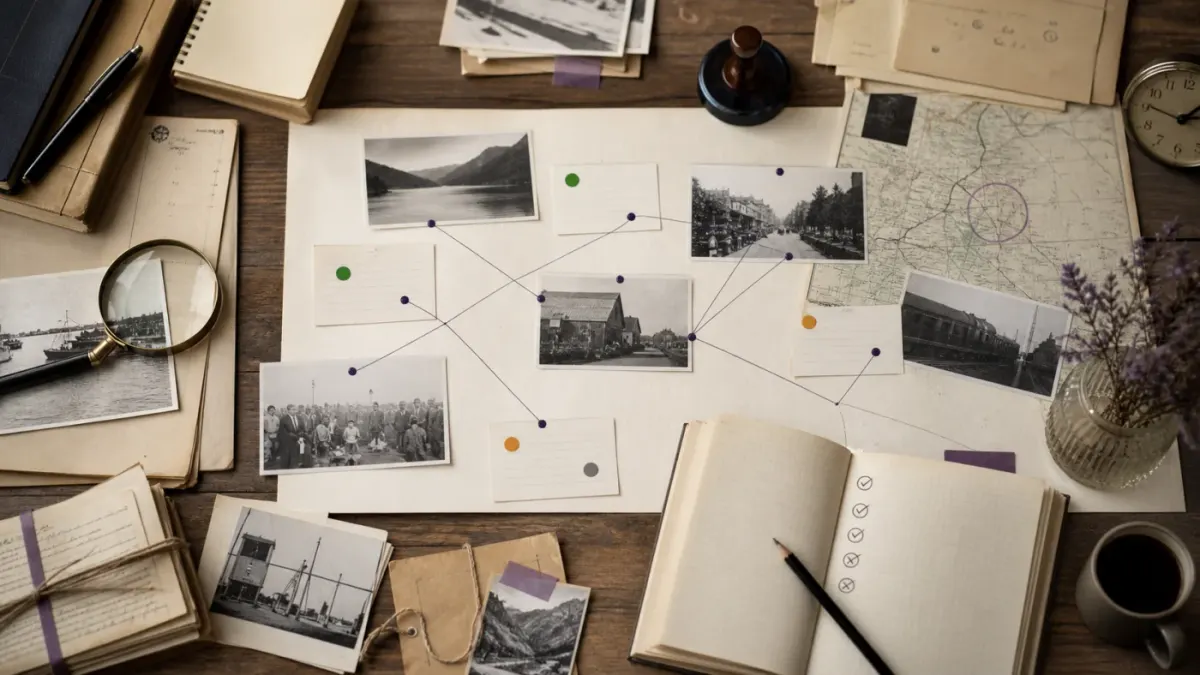
Create a simple evidence file with five columns: claim, source, date, exact support, and confidence. The exact support can be a short quotation, a page number, a dataset field, or a note describing where the evidence appears. Confidence can be high, medium, or unresolved. The purpose is not academic ceremony. It is to stop a claim from becoming “true” merely because it survived several rounds of rewriting.
| Claim type | Prefer | Watch for |
|---|---|---|
| Date, law, vote, or official action | Government record or original document | Later articles repeating the wrong date |
| Scientific finding | Published paper and reputable review | Press releases that overstate the result |
| Company decision or financial result | Filing, earnings material, or direct statement | Anonymous summaries without the original context |
| Historical event | Archives, contemporary records, and established scholarship | A memorable anecdote with no traceable source |
| Personal motive | Direct testimony supported by context | Presenting speculation as a known inner thought |
Use secondary sources to understand the landscape, then follow their citations toward primary material where possible. A good secondary source explains the context, weighs disagreement, and points to evidence. A weak one repeats confident claims without showing how they are known. Wikipedia can help you find names, terms, dates, and references, but the documentary should not end its research there.
Keep a second list called “interesting but unverified.” This protects the main script without throwing away a promising lead. Many documentary errors begin as colorful details that feel too good to remove. Moving them out of the verified notes makes the status clear. If you later find solid support, they can return. If not, they do not belong in the narration.
Record disagreement instead of flattening it
Some subjects do not have one settled answer. Sources may disagree because records are incomplete, definitions differ, or later evidence changed the picture. Do not force certainty for the sake of a clean ending. Write the disagreement into the structure: what is known, what each explanation claims, what evidence supports it, and what remains unresolved. Honest uncertainty often creates more tension than a false conclusion.
When the subject involves health, finance, elections, active conflict, or a living person's reputation, raise the standard. Use current authoritative sources, describe limits, and avoid letting a generated reconstruction carry a claim the narration could not support. If the stakes are high or the facts are disputed, get a qualified reviewer before publishing.
Turn the research into a documentary structure
A source file is not a script. Research is arranged by where information was found. A documentary is arranged by what the viewer needs next. The structure should create a sequence of questions and answers. Each section resolves something while opening the next useful question.
A reliable structure has five movements. The opening presents the mystery or contradiction. Context shows why the subject matters and gives the viewer enough background to follow. The core follows the main chain of cause and effect. A turn introduces evidence that changes or complicates the easy explanation. The ending answers the opening question and shows the consequence without pretending every uncertainty has vanished.
- 1Hook: show the surprising result, unanswered question, or contradiction in the first 15 to 30 seconds.
- 2Context: establish the place, time, people, and stakes with only the details needed for the story.
- 3Investigation: move through the strongest evidence in a clear chain, not a pile of facts.
- 4Turn: reveal the overlooked cause, competing explanation, failed assumption, or new evidence.
- 5Payoff: answer the central question, explain why it matters, and leave the viewer with one precise final thought.
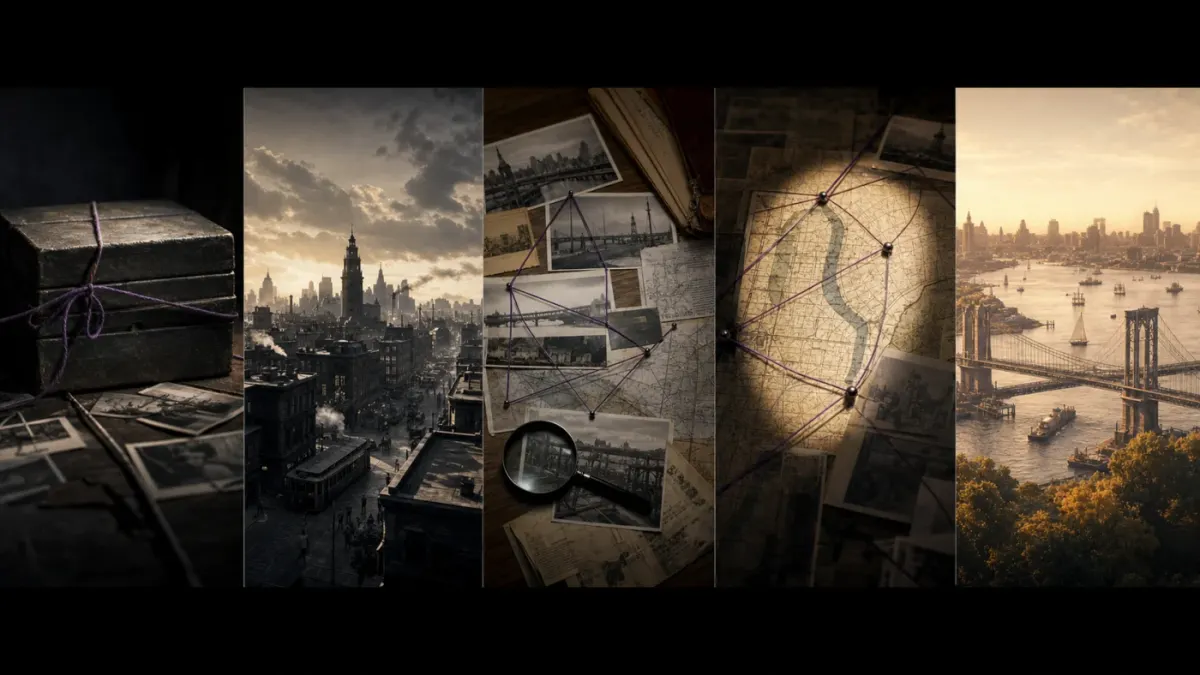
For a short documentary, each movement may be one or two sentences. For a ten-minute video, the investigation can contain several chapters. The shape remains useful because it prevents two common problems: an opening that spends too long on background and an ending that merely stops after the last fact.
Outline with evidence attached
Write each outline beat as a claim followed by its support. “The team ignored three warning signs” is not enough. Name the signs and attach the record that establishes each one. “The city grew quickly” should connect to a measured change, a map, a census, or a contemporary account. This makes empty sections visible before you spend time polishing narration.
Then add the viewer question under every beat. After hearing this section, what will the viewer want to know next? If the answer is “nothing,” the story may have lost its forward motion. The next beat should either satisfy that curiosity or deliberately delay it while delivering something necessary.
Write narration for the ear, not the page
A documentary script is heard once at the speed of playback. The viewer cannot scan backward as easily as a reader. Sentences need to be shorter, connections need to be clearer, and important names or numbers need space around them. Simple English is not a lack of depth. It is how complex ideas survive the move from page to voice.
Write one idea per sentence. Prefer concrete verbs. Replace abstract clusters with actions the viewer can picture. “A rapid deterioration of institutional confidence occurred” becomes “Investors stopped believing the bank could survive.” Use a technical term when it is the correct term, then explain it with a plain example before moving on.
- Read every paragraph aloud. If you run out of breath, shorten it.
- Introduce no more names, dates, or numbers than the next scene can support.
- Repeat an important name when a pronoun could refer to two people.
- Use signposts such as “the first problem,” “three years later,” and “that changed when.”
- Cut throat-clearing phrases that delay the claim.
- Describe uncertainty directly: “The records do not show why,” or “Historians disagree on this point.”
- End sections on a consequence or question, not a generic promise to continue.
Do not make every line dramatic. If every fact is shocking, nothing feels important. A calm sentence can give the viewer time to understand the evidence. Reserve emphasis for real changes in the story: the decision that closed an option, the document that contradicted a public claim, or the result nobody expected.
Match the script to the intended duration
Natural documentary narration often lands around 125 to 155 words per minute, depending on pauses, names, quotations, and visual complexity. Treat that as a planning range, not a speed target. A five-minute film may need roughly 650 to 750 spoken words. A ten-minute film may need around 1,300 to 1,500. Dense scientific or historical material usually benefits from the slower end.
Leave room for the image to speak. A map animation, quotation, comparison, or sequence of documents may need two quiet seconds after the narration introduces it. If the voice explains every visible detail without pause, the viewer must choose between listening and looking. The final timing should come from a read-through against the storyboard, not a word count alone.
Build a visual storyboard that proves, explains, and changes
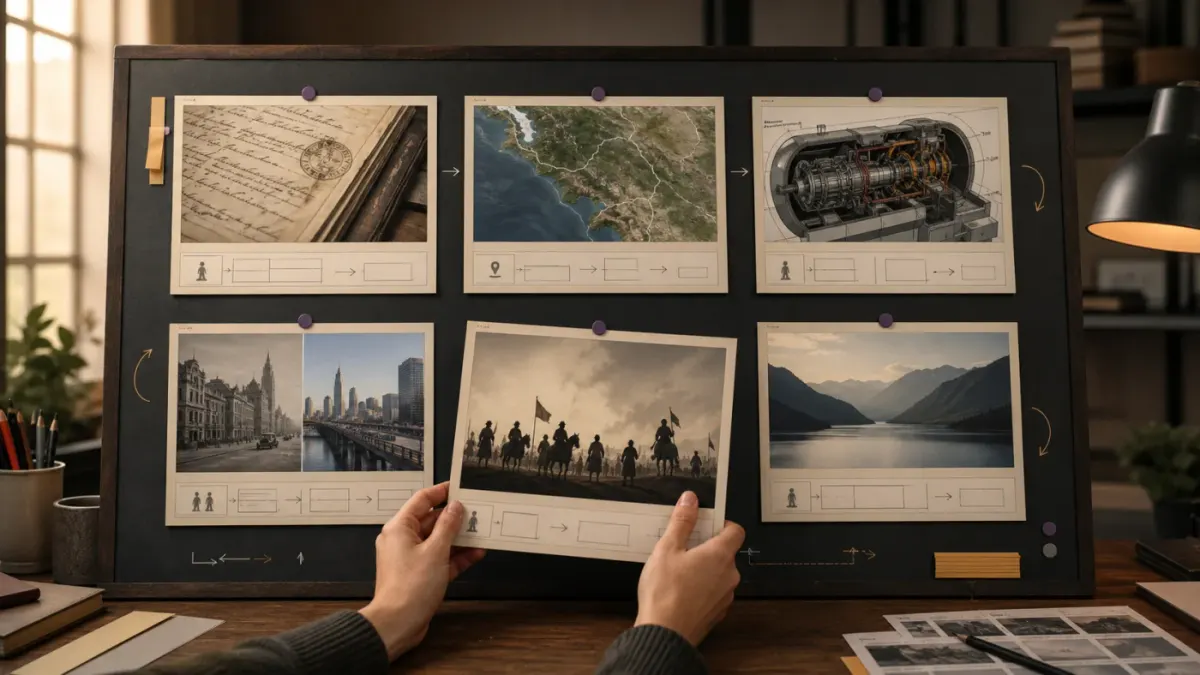
Weak faceless documentaries treat visuals as wallpaper. The narration mentions a factory, so the video shows any factory. It mentions fear, so the video shows a worried face. The images may be attractive, but they add no information. A strong storyboard gives each scene a job.
A documentary visual can show evidence, establish a place, explain a process, compare two states, reveal scale, mark time, or create a carefully labeled reconstruction. Write that job beside every scene. If two adjacent scenes do the same job in the same way, change one. Visual variety should come from the needs of the story, not random style changes.
| Visual job | Useful material | Question to ask |
|---|---|---|
| Prove | Document, quotation, record, photograph, or data | Can the viewer see the basis of the claim? |
| Locate | Map, aerial view, route, exterior, or period image | Does the viewer understand where this happens? |
| Explain | Diagram, labeled object, process sequence, or model | Is the mechanism easier to understand now? |
| Compare | Before and after, two designs, two timelines, or two outcomes | Is the meaningful difference visible? |
| Reconstruct | Clearly framed generated scene or illustration | Could anyone mistake this for authentic footage? |
| Breathe | Atmosphere, environment, texture, or slow detail | Does this pause support the mood without making a claim? |
Plan the visual change at the level of the idea. A scene can last longer when something within it develops: a route draws across a map, labels appear in sequence, a crop moves from a full document to one line, or a comparison changes from before to after. A static image held under six unrelated sentences feels slow even if the camera drifts across it.
Write scene prompts with factual boundaries
A useful image prompt states the subject, action, setting, camera, light, period, and any boundary the model must respect. For a reconstruction, it should also say what is known and what should remain generic. If the records establish the building but not the people inside it, do not invent a recognizable meeting and present it as fact. Use a wider environmental reconstruction or an object-level detail instead.
Avoid prompts that ask for a famous visual style or copy a living artist. Describe the qualities the scene needs: restrained color, period-accurate clothing, overcast natural light, observational framing, archival grain, or technical cutaway. Keep names and dates out of generated text inside images because image models can produce convincing nonsense. Add accurate labels later in the edit.
Choose the right mix of still images and AI video clips
More motion does not automatically create a better documentary. Still images are often the honest and economical choice for documents, portraits, maps, diagrams, archive material, and moments where the viewer needs to inspect detail. Slow pans, crops, layers, and simple parallax can create movement without making the source harder to read.
AI video clips work well for establishing atmosphere, showing a general process, visualizing scale, or creating a short reconstruction that is clearly presented as synthetic. They are less reliable for exact historical actions, readable documents, precise machinery, or a sequence where the same person and place must remain perfectly consistent across many shots.
| Use mostly stills when | Use selected AI clips when |
|---|---|
| The evidence itself must stay readable | Environmental motion helps establish place or scale |
| Accuracy matters more than spectacle | The scene is illustrative rather than evidentiary |
| The budget needs to cover many scenes | A turning point benefits from a brief cinematic beat |
| You have strong photographs, maps, or diagrams | Natural movement is central to understanding the process |
| A generated action could mislead the viewer | The synthetic nature of the reconstruction is clear |
A hybrid cut is usually the strongest default. Let evidence and explanation carry most of the film. Spend motion on the opening, section transitions, environments, and a few moments where movement adds meaning. This creates contrast and keeps generation cost under control. It also reduces the chance that visual errors accumulate across dozens of clips.
Use voice, music, and captions with restraint
The narrator is the viewer's guide through unfamiliar material. Choose a voice that can remain clear and believable for the full duration. A highly theatrical delivery can work for mystery or dramatic history, but it becomes tiring when every sentence carries the same heavy importance. Science, business, and explanatory subjects often benefit from a calmer voice with precise pauses.
Generate a short voice test before the full narration. Include a proper name, a date, a quotation, a number, and one technical term from the script. Fix pronunciation at the script level where possible. Listen through headphones and a phone speaker. A voice that sounds rich in headphones may lose clarity on a small speaker when music and captions are added.
Music should shape the room around the narration, not compete with it. Choose a consistent musical world, then change intensity at structural moments. The opening may carry a pulse, the evidence section may become sparse, and the turn may introduce a new texture. Avoid using tragic music to force emotion where the facts do not earn it. Lower the music further under names, figures, quotations, and conclusions.
Captions are useful even in long-form work. They support viewers watching quietly, improve clarity around unfamiliar terms, and help maintain attention. They should break at natural phrases and remain inside safe areas. Do not cover a face, map label, quotation, or important object. For a reflective documentary, line-level captions often feel calmer than rapid word-by-word highlighting.
- Keep the narrator louder and clearer than every other sound.
- Use silence before or after an important fact when the moment needs weight.
- Check pronunciation before rendering the complete voice track.
- Add on-screen names and dates in the editor, not inside generated images.
- Use one caption system consistently rather than changing style by scene.
- Listen once without looking to catch confusing logic and abrupt audio edits.
- Watch once on mute to test whether the visual sequence still makes sense.
How to create an AI documentary step by step
The following workflow works whether you assemble the film across several tools or use an end-to-end system. FacelessGenie brings the script model, voice, scene images, optional image-to-video clips, captions, music, and render into one project. The important part is the order: evidence before polish, structure before generation, and a complete review before publishing.
- 1Write the documentary question and one-sentence viewer promise. Choose a clear audience and target duration.
- 2Collect reliable sources in an evidence file. Separate verified claims, disputed claims, and interesting leads that still need support.
- 3Build a five-part outline: hook, context, investigation, turn, and payoff. Attach evidence to every factual beat.
- 4Draft the narration in simple spoken language. Read it aloud and remove anything the viewer cannot follow at playback speed.
- 5Split the script into scenes. Give every scene one visual job such as prove, locate, explain, compare, reconstruct, or breathe.
- 6Choose still images for evidence and precise explanation. Reserve AI clips for moments where motion adds real value.
- 7Generate a short voice test and confirm tone, pacing, pronunciation, and clarity before producing the full track.
- 8Create the first full draft with captions and restrained music. Do not polish isolated scenes before the complete story exists.
- 9Run an accuracy pass against the evidence file and a visual-truth pass for any generated reconstruction.
- 10Watch the complete video on a phone and desktop, make final cuts, add disclosure where required, and publish with source notes.
The FacelessGenie workflow
Open Create and choose AI Images B-roll for the most economical long-form documentary setup. It uses a 16:9 composition, narrator-led structure, generated still scenes, captions, music, and measured movement across the images. It is a sensible starting point for history, science, technology, psychology, and nature topics.
Use AI Clips when the story needs generated motion in every scene, or treat it as an upgrade path after testing the still-image version. Choose the script, voice, image, and video models according to the needs of the project. A research-heavy script benefits more from a strong reasoning model than a simple list does. A long voiceover deserves a natural voice you can listen to for ten minutes. A visual reconstruction may justify a stronger image model, while a map or quotation should be built for accuracy rather than cinematic texture.
Paste a verified brief rather than a vague topic. Include the central question, audience, target length, key evidence, required sections, disputed points, pronunciation notes, visual rules, and the conclusion the evidence supports. Review the generated script before approving scenes. Then inspect the storyboard for repeated compositions, misleading reconstructions, incorrect period details, and images that merely echo a noun from the narration.
Protect accuracy and disclose realistic AI scenes
A documentary asks the viewer to trust the relationship between words and images. Generated media can weaken that trust when it looks like evidence. A photoreal scene of a real event may be understood as archival footage even if the narration never calls it real. The creator must make the boundary visible.
Label reconstructions in the video when they could be mistaken for authentic material. Phrases such as “AI reconstruction,” “artist's reconstruction,” or “illustrative scene” are simple and clear. Keep the label readable for the duration of the shot. Do not apply fake film damage, dates, camera marks, or news graphics that make synthetic footage look more authentic than it is.
YouTube requires creators to disclose meaningfully altered or synthetic content when it appears realistic, including realistic scenes that did not occur, altered footage of real places or events, and a real person made to appear to say or do something they did not. YouTube's altered or synthetic content guide explains the upload setting and current examples. The platform also says that making the disclosure does not by itself reduce monetization eligibility.
Disclosure is not a substitute for accuracy. A label does not make a false claim acceptable. Check every name, title, place, date, quotation, statistic, causal statement, and superlative such as “first,” “largest,” or “only.” Check the final edit, not just the script, because a caption, image, map, or cut can introduce a new implication.
Use three separate review passes
- 1Claim review: compare every factual statement with the evidence file and confirm uncertainty is described honestly.
- 2Visual review: ask what each scene appears to prove and whether a viewer could mistake illustration for evidence.
- 3Meaning review: watch the completed sequence for misleading cause and effect created by music, juxtaposition, or omitted context.
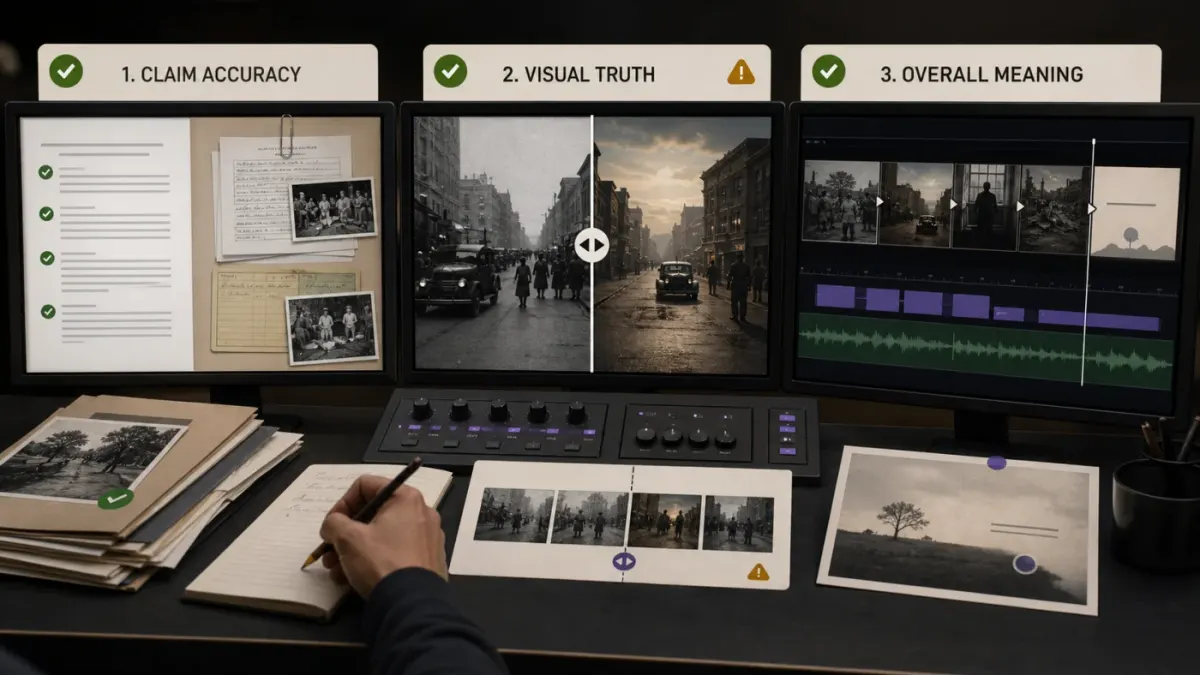
These passes should be separate because a beautiful cut makes errors harder to notice. During claim review, ignore style. During visual review, mute the audio and examine the images. During meaning review, watch normally and ask what conclusion a reasonable viewer would carry away. Fix the conclusion they will actually receive, not only the words you intended.
Use archives, music, and source material safely
Documentaries often need material created by other people: photographs, footage, maps, newspaper pages, recordings, music, and written sources. Finding an asset online does not mean it is free to use. Credit is good practice, but credit alone does not create permission.
Use material you created, licensed, received permission to use, or confirmed is available under terms that cover your use. Public-domain and Creative Commons material can be valuable, but check the exact work, jurisdiction, license version, attribution requirements, and whether a collection page adds its own conditions. Keep a record of the source page and license at the time you downloaded the asset.
Fair use is a case-specific legal doctrine, not an editing trick. Commentary, criticism, research, teaching, and news reporting can support a fair-use argument in the United States, but courts weigh several factors and only a court can finally decide. YouTube's fair use guide explains the four factors and warns that even short uses can receive Content ID claims. Rules differ outside the United States, so get legal advice when the risk matters.
Music creates frequent problems because a claim can affect monetization even when the track is only background. Use music whose commercial terms you understand, retain proof of the license, and avoid assuming that “royalty free” means free of conditions. Original generated music can reduce dependence on stock libraries, but review the provider's commercial terms and do not imitate a named artist.
- Save the creator, source URL, license, download date, and required credit for every external asset.
- Use only the amount of third-party material needed for the documentary purpose.
- Add real commentary, analysis, or explanation instead of replaying material as decoration.
- Do not remove watermarks or ownership marks from source material.
- Keep generated reconstructions visually separate from authentic archive evidence.
- Replace uncertain music and footage before publishing rather than hoping a claim will not appear.
Make the documentary original enough to deserve an audience
The easiest AI documentary to produce is also the easiest for viewers to forget: a generic script, a familiar synthetic voice, unrelated images, and the same template repeated across dozens of subjects. Production volume cannot repair the absence of a point of view.
YouTube's current channel monetization policies say monetized content should be original and authentic, not mass-produced, generic, or repetitive. The examples specifically include AI-generated videos made with generic or unoriginal templates that give the impression of mass production without the creator's own insight. Image slideshows with little narrative, commentary, or educational value can also fail the standard.
The answer is not superficial variation. Changing the color, voice, or title does not make the substance new. Original value can come from a better question, direct research, a useful synthesis of several sources, a carefully argued explanation, an original diagram, a new comparison, a local case study, or a conclusion that follows transparently from evidence.
| Generic production | Original documentary work |
|---|---|
| Summarizes the first search results | Builds a traceable evidence file and resolves conflicts |
| Uses the same hook for every topic | Opens with the specific contradiction inside this story |
| Matches nouns to random B-roll | Gives every visual a factual or storytelling job |
| Hides uncertainty to sound confident | Explains what is known, disputed, and still missing |
| Repeats one template at scale | Uses a repeatable workflow while changing the substance |
| Publishes the first generated cut | Adds human review, direction, corrections, and a clear point of view |
A series can still share an intro, narrator, caption style, music family, and visual language. Consistency helps viewers recognize the channel. The topic, evidence, story, examples, scene logic, and conclusion should materially change from episode to episode. Think of the workflow as a studio process, not a content mould.
A practical production plan for your first documentary
Do not begin with a 20-minute investigation. A five-minute film is long enough to test research, narration, visual rhythm, and audience response while keeping the review manageable. Choose a question with accessible sources and a conclusion you can support without interviews or original location footage.
| Stage | Output | Stop condition |
|---|---|---|
| Question | One-sentence promise and audience | The story can be answered in one focused video |
| Research | Evidence file with primary and strong secondary sources | Every major claim has support or is marked unresolved |
| Outline | Five-part story with evidence attached | Each section leads naturally to the next question |
| Script | Spoken draft at the target duration | A read-through is clear without seeing the page |
| Storyboard | One visual job and source plan per scene | No scene depends on a misleading reconstruction |
| First cut | Complete voice, visuals, captions, and rough music | The full story works before detailed polish |
| Review | Claim, visual, meaning, copyright, and platform checks | A skeptical viewer would not be misled |
Keep a production log after publishing. Record where research took too long, which words needed pronunciation fixes, which scenes required manual replacement, and where viewers stopped watching. The purpose is to improve the next process, not to automate every difference away.
Improve one variable in the second film
If the first opening is slow, improve the hook and keep the rest of the workflow stable. If the script is clear but the visuals repeat, improve storyboard variety. If viewers stay through the investigation but leave before the conclusion, shorten the final section and deliver the answer sooner. Changing everything at once makes it impossible to know what helped.
Build reusable assets that do not make the substance repetitive: an evidence-file template, a pronunciation sheet, a source-credit format, a caption preset, a map style, and a final review checklist. These save time while protecting quality. The research and argument should remain specific to each film.
AI documentary checklist before you publish
Watch the final export from beginning to end without editing. Take notes, but do not pause unless you find a serious error. This reveals the real viewing experience: repeated ideas, exhausting music, confusing names, slow sections, abrupt cuts, and conclusions that arrive after the emotional energy has already ended.
- The title and opening make one clear factual promise.
- The documentary answers a question rather than covering a broad topic.
- Every important claim is linked to reliable evidence in the production file.
- Disagreement and uncertainty are stated honestly.
- Names, dates, quotations, statistics, and superlatives have been checked.
- Every scene proves, locates, explains, compares, reconstructs, or gives a deliberate breath.
- Generated reconstructions cannot be mistaken for authentic footage.
- Realistic synthetic content is labeled and disclosed where required.
- The narration is easy to follow at normal playback speed.
- Pronunciations have been tested in the final voice.
- Music supports the structure and remains below the narration.
- Captions are accurate, readable, and clear of important visual information.
- External images, footage, documents, and music have safe usage terms and recorded credits.
- The video adds original research, explanation, synthesis, or perspective.
- The ending answers the opening question without overstating the evidence.
- The export has been checked on both a phone and a desktop screen.
Frequently asked questions
The best choice is the one that gives you control over the full workflow: script, voice, visual style, scene planning, captions, music, and final review. FacelessGenie supports both still-image B-roll and AI video clip workflows, with model choice for each production stage. The tool matters, but source quality and human editorial review matter more.
Ship your first faceless video today.
Pick your niche. Pick your models. We render. From idea to finished short in under 7 minutes — no camera, no editor.
Keep reading
How to Start a Faceless Channel in 2026: Complete Guide
A practical, cross-platform system for turning one clear channel idea into original YouTube videos, Shorts, faceless Reels, and TikToks without appearing on camera.
AI Video Script Generator 2026: Scripts That Hold Retention
Score your script before you generate: anything under a 7 out of 10 will render clean and still get skipped. Here is the hook-to-payoff system that fixes that.
YouTube Automation in 2026: What Actually Makes Money
Most YouTube automation guides are written by people who've never shipped 100 videos. This one comes from an operation that ships that many every month, with the numbers the gurus skip.