How to Start a Faceless Channel in 2026: Complete Guide
A practical, cross-platform system for turning one clear channel idea into original YouTube videos, Shorts, faceless Reels, and TikToks without appearing on camera.
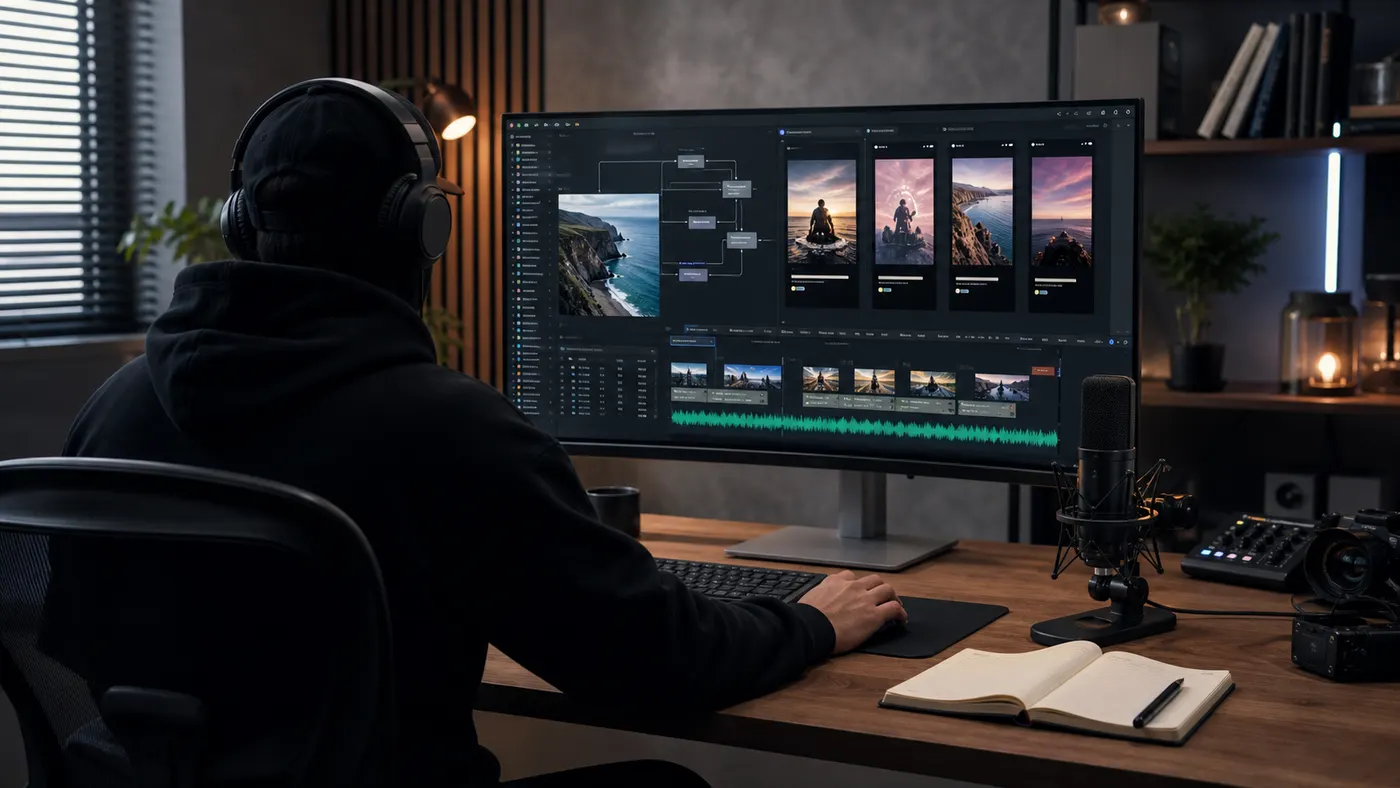
You do not need to become the product to build an audience. A useful idea, recognizable editorial style, and reliable publishing system can carry a channel without your face on screen. In a faceless channel, the subject stays central while narration, visuals, characters, screen recordings, or animation handle the presentation.
The opportunity is bigger than faceless YouTube. One researched topic can become a landscape video, YouTube Short, Instagram Reel, and TikTok cut. Each edit should suit its platform, but the insight does not need reinvention. A strong system separates research, angle, script, and identity from repeatable narration, scene generation, captions, rendering, and resizing.
This guide covers the complete system: niche, channel promise, formats, idea bank, scripts, production, repurposing, analytics, and monetization. For topic inspiration, see our faceless YouTube channel ideas. Here, you will learn how to turn one idea into an actual channel.
What is a faceless channel?
A faceless channel publishes videos without making the creator's face the main visual identity. The creator can remain anonymous, use their own name without appearing, build a fictional host, or operate a brand account. The defining feature is not secrecy. It is that the audience comes for the information, story, world, or character rather than for a conventional talking-head presenter.
Faceless videos can still feel personal. Your point of view appears in the topics you choose, the questions you ask, the examples you include, the jokes you keep, and the conclusions you reach. A history channel can have a skeptical voice. A productivity channel can feel calm and practical. A fictional talking-object series can express the creator's humor through recurring characters. Removing the camera does not remove authorship.
The format also does not require AI. Hands-only demonstrations, original animation, documentary footage, screen recordings, overhead cooking videos, narrated slides, and stop-motion have existed for years. AI makes production faster by helping with scripts, voices, images, animation, captions, and editing, but a faceless AI video still needs an editorial reason to exist. Pressing generate is a production action, not a content strategy.
| Channel type | What viewers see | What builds trust |
|---|---|---|
| Narrated documentary | Original images, clips, maps, charts, and captions | Research, structure, and a clear point of view |
| Screen-recorded tutorial | Software, workflow, or on-screen process | Useful demonstration and accurate instruction |
| Character channel | A consistent fictional host or recurring cast | Personality, continuity, and strong writing |
| Hands-only channel | Craft, cooking, repair, drawing, or unboxing | Visible skill and a satisfying process |
| Atmospheric faceless Reels | Cinematic scenes, text, voiceover, and music | Relatable insight, mood, and shareability |
Why faceless content works—and why it sometimes fails
Faceless content works because it lowers the cost of showing up. You do not need a studio-ready room, makeup, lighting, multiple takes, or the confidence to perform on camera. That makes batching easier. A creator can research five related topics, write five scripts, generate or collect the visuals, record narration, and finish the batch without scheduling five separate shoot days.
It also gives the topic more visual freedom. A talking head discussing the fall of an empire remains a person in a room. A faceless history video can move through maps, reconstructed cities, documents, portraits, and battle routes. A finance creator can show numbers, decisions, and consequences instead of asking the audience to watch a presenter read them. When the visual changes serve the script, a faceless video can feel more cinematic than a conventional creator video.
The failure mode is just as clear: removing the presenter can remove the only human signal. Generic voiceover over unrelated stock footage gives viewers no reason to remember who made the video. Repeating the same template with slightly different facts creates output, not a channel. The answer is not to show your face. The answer is to replace physical presence with editorial presence: recognizable writing, visual decisions, recurring segments, reliable depth, and a point of view.
“Faceless is a production choice. Forgettable is a creative choice.”
Choose a niche you can sustain for 100 videos
Do not choose a niche because one account posted a viral screenshot. Choose it because you can repeatedly make useful or entertaining decisions inside it. A niche is not merely a subject such as finance, history, or fitness. It is an audience, a recurring problem, and a recognizable angle. “Personal finance” is broad. “Money systems for freelancers with uneven income” tells you who the video is for and which questions belong on the channel.
Use four tests before committing. First, demand: do people already watch, search for, save, or discuss this subject? Second, depth: can you list 50 specific video ideas without repeating the same premise? Third, visual fit: can the topic be shown through scenes, demonstrations, characters, charts, or screen recordings? Fourth, business fit: can the audience eventually support ads, affiliates, services, products, sponsorships, memberships, or leads?
- Strong educational niche: explain one difficult topic to one defined audience, such as practical AI workflows for solo real-estate agents.
- Strong story niche: tell a specific class of stories, such as failed products, overlooked historical decisions, or strange engineering disasters.
- Strong utility niche: help viewers complete a repeated task, such as editing mobile photos, learning spreadsheet shortcuts, or planning low-cost meals.
- Strong entertainment niche: build a repeatable world, cast, or conflict, such as talking office objects surviving workplace problems.
- Weak niche: anything described mainly as “viral videos,” “random facts,” or “whatever is trending.” It has no audience promise and no compounding identity.
Turn the niche into a clear channel promise
Your channel promise is the reason someone subscribes after enjoying one video. A good video answers one question. A good channel promises more answers of the same valuable kind. The promise should shape your name, bio, thumbnails, titles, recurring formats, and the final line of each video. It should be specific enough to exclude ideas that do not belong.
Build three content pillars under that promise. A faceless channel for freelancers might use “earn,” “manage,” and “protect” as pillars. A strange-history channel might use “lost places,” “failed inventions,” and “decisions that changed borders.” Three pillars create variety without confusing the audience. Each pillar can support a recurring short series and a deeper long-form series.
Next, define recognizable packaging. Choose one caption behavior, one narration personality, one thumbnail logic, and a small set of visual treatments. Consistency helps a viewer identify your content before reading the username. Do not confuse this with using the exact same template forever. The frame can be familiar while the substance, scenes, examples, and conclusions change materially from video to video.
Choose a repeatable faceless-video format
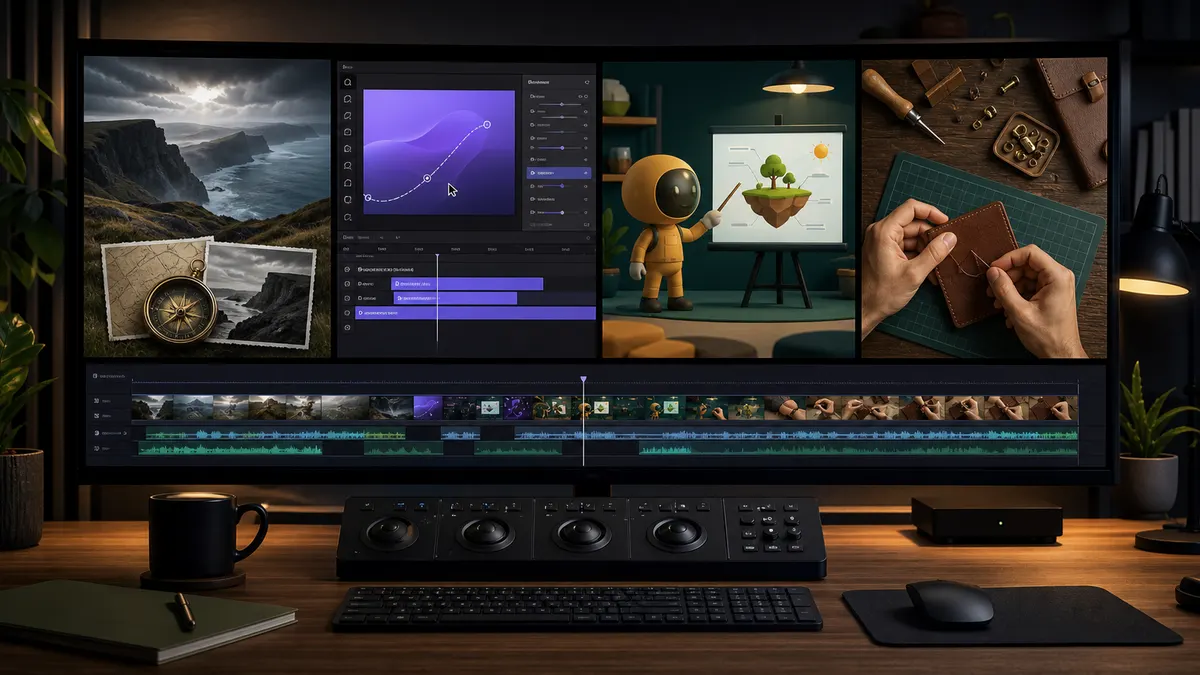
The best format is the one that makes your idea clear while staying affordable enough to publish consistently. A cinematic AI clip can be valuable for a dramatic opening but unnecessary for every sentence of a software tutorial. A screen recording is perfect when the proof is on screen and weak when the topic is an emotional story. Match production effort to the viewer's reason for watching.
1. Narrated visual stories and explainers
A voice leads while images, animated clips, maps, diagrams, captions, and occasional text carry the visual story. This format fits history, science, business, philosophy, travel, true stories, and practical explainers. The script needs visual nouns: people, objects, locations, numbers, and actions that can become scenes. If the writing stays abstract for too long, the visuals become generic wallpaper.
2. Screen recordings and process videos
Show the actual workflow while narration explains decisions. This is the strongest faceless format for software, design, productivity, coding, research, and online business. Zoom into the relevant area, remove dead time, and explain why each step matters. The cursor should not wander while the narration discusses something else.
3. Consistent characters and animated hosts
A fictional character becomes the recognizable face of a faceless brand. The host can explain, react, interview another character, or move through a story. This works for education, comedy, serialized fiction, and younger audiences. Character consistency matters more than maximal realism. A simple host that looks and sounds the same every week builds more memory than a spectacular new avatar in every post.
4. Talking objects and recurring casts
Objects turn concepts into characters. A Wallet and Credit Card can argue about spending; an Inbox and Calendar can debate productivity. The format supports fast faceless Reels as well as longer conversations. Our talking objects production guide covers casting, dialogue, consistency, and short-versus-long structure in depth.
5. Gameplay, satisfying loops, and commentary
Continuous motion holds the visual field while narration carries a story or opinion. It is fast to produce, but the background must be licensed and the commentary must be worth hearing. Gameplay cannot rescue a weak script. Treat it as pacing support, not as borrowed attention you can reuse without adding value.
6. Hands-only demonstrations
Cooking, crafts, repair, journaling, product testing, drawing, and unboxing can show proof without showing a face. This format is less automated but highly original because the footage demonstrates real work. AI can still help outline the sequence, clean narration, create captions, design the thumbnail, and repurpose the result.
Build one brand for YouTube, Reels, Shorts, and TikTok
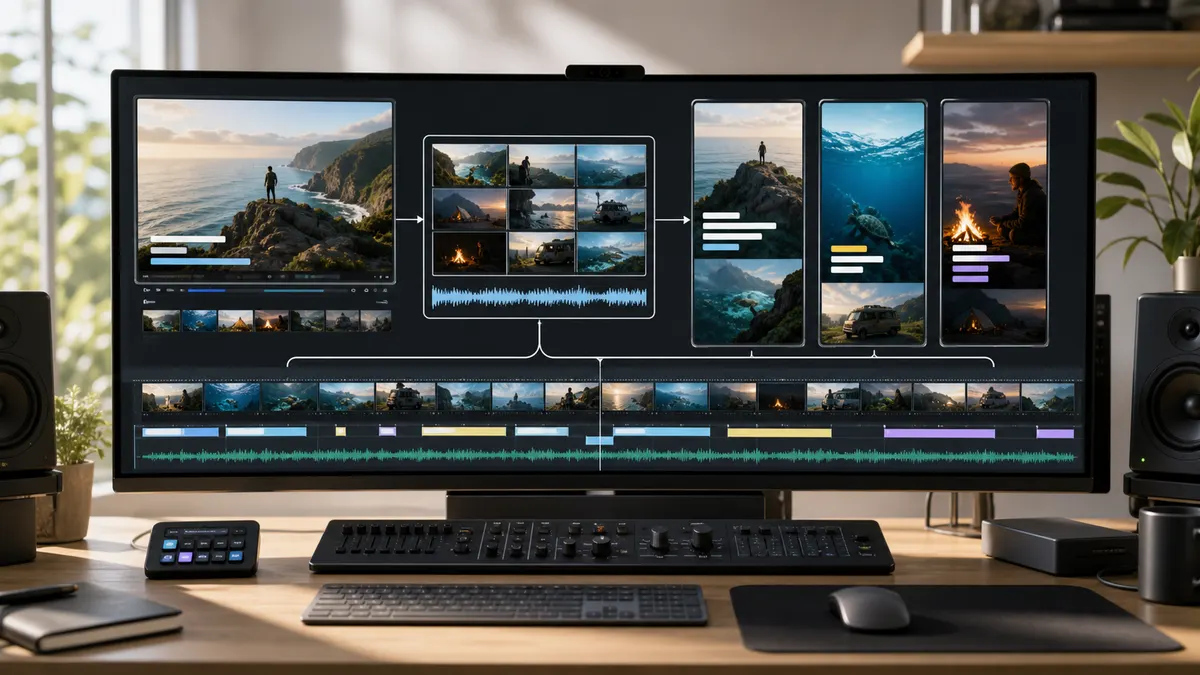
Cross-platform does not mean uploading an identical file everywhere and walking away. It means building one editorial engine with several distribution edits. YouTube long-form rewards depth and session value. YouTube Shorts, Instagram Reels, and TikTok need immediate context, tighter framing, and faster visual change. The topic and evidence can stay consistent while the opening, duration, captions, soundtrack, and CTA adapt.
| Surface | Primary job | Useful starting format | Edit priority |
|---|---|---|---|
| YouTube long-form | Depth, search, trust, and watch time | 6–12 minute 16:9 video | Title, thumbnail, structure, and sustained value |
| YouTube Shorts | Discovery and fast topic validation | 20–60 second 9:16 story or insight | First frame, engaged views, and clean payoff |
| Instagram Reels | Shares, saves, identity, and community | 15–45 second 9:16 reel | Relatable hook, visual polish, and saveable takeaway |
| TikTok | Rapid discovery and conversational feedback | 15–60 second native-feeling cut | Direct hook, pacing, comments, and cultural fit |
YouTube currently categorizes vertical or square uploads up to three minutes as Shorts for standard channels, but the maximum is not a target. Use the shortest duration that completes the promise. YouTube also keeps an “Engaged views” metric so creators can distinguish people who chose to continue watching from simple starts or replays. Review the current official Shorts guidance before building duration assumptions into a permanent workflow.
Instagram's professional dashboard includes a Best Practices area with account-specific guidance across creation, engagement, reach, monetization, and guidelines. Use that first-party feedback instead of treating a universal posting-time chart as law. Our separate faceless Reels guide goes deeper on Instagram-specific packaging, while this guide keeps the channel system unified.
Build a content system before you build a content calendar
A calendar tells you when to publish. A content system tells you what deserves production and how one successful idea creates several useful assets. Start with an idea bank divided by your three pillars. Every idea should include the audience question, the promised outcome, the surprising angle, the proof or examples required, and the best visual format.
Collect ideas from recurring questions, search suggestions, comments, customer conversations, community discussions, product reviews, public datasets, books, papers, and your own experience. Do not copy another creator's title and ask AI to paraphrase their script. Trace the audience need back to a source you can investigate independently. Original research can be small: testing three workflows, comparing five examples, documenting one attempt, or explaining a decision with clearer evidence.
- 1Capture the raw question: what is the viewer trying to understand, avoid, choose, or achieve?
- 2Write a one-sentence answer before researching. This exposes what you currently believe and what must be verified.
- 3Collect primary sources, direct examples, and counterexamples. Save links beside the idea instead of hunting for them during scripting.
- 4Choose the angle: beginner explanation, comparison, experiment, mistake analysis, story, checklist, teardown, or contrarian argument.
- 5Design the long-form promise and three possible short-form hooks. If none feels specific, the idea is not ready.
- 6Assign the idea to a recurring series so viewers understand where it belongs in the channel.
How to script a faceless video people finish
A faceless script must carry more visual information than a talking-head script because there is no presenter performance to bridge vague sections. Write narration and visual intent together. Each beat should either advance the answer, create a useful question, show evidence, or deliver the payoff. If a paragraph does none of those things, remove it before generation.
A short-form script: hook, context, turn, payoff
Open with the consequence or contradiction, not an introduction. “This budgeting rule fails freelancers every January” creates a problem. “Here are three budgeting tips” announces a list. Give only enough context to understand the tension, then reveal the mechanism, example, or mistake. End by resolving the opening rather than fading into a generic follow request.
- Hook: make one specific promise or expose one specific tension in the first sentence.
- Context: name the situation and why the obvious answer fails.
- Turn: introduce the useful distinction, evidence, or change in perspective.
- Payoff: give the answer, result, or final story beat the opening earned.
- CTA: invite the next logical action only when it helps—save the checklist, watch the full breakdown, or try the workflow.
A long-form script: promise, route, proof, progression
Long-form needs a route. State the problem and destination, show the viewer how the video will get there, then make each section answer a smaller question. Use examples before abstractions where possible. Re-open curiosity at natural transitions, but do not manufacture suspense by withholding a simple answer for ten minutes. Viewers should feel progress throughout the video.
Read every script aloud before rendering. Remove phrases you would never say, split long sentences, and listen for paragraphs where the cadence never changes. A good narration script has contrast: short statements after dense explanations, questions before answers, and pauses before important turns. Our AI video script generator guide includes reusable structures for tutorials, explainers, stories, and Shorts.
The complete faceless-video production workflow
Production becomes manageable when every stage has one clear output. Research produces a verified brief. The brief produces a script. The script produces narration and a scene plan. The scene plan produces visual assets. Those assets enter a timeline with captions, music, and sound. Review produces a list of specific corrections rather than a vague feeling that the video is not good enough.
- 1Brief. Define the viewer, promise, angle, sources, format, target duration, CTA, and the one fact or scene that must be remembered.
- 2Script. Write the spoken track and mark where the visual subject changes. Verify names, claims, pronunciations, and numbers before recording.
- 3Narration. Record your own voice or generate a licensed AI voice. Lock the final audio before timing dozens of scenes around a draft.
- 4Storyboard. Break the narration into beats. Give every beat a purpose, subject, framing, motion idea, and expected duration.
- 5Visual generation or capture. Record screens, film hands, create images, generate clips, build charts, or combine methods according to the storyboard.
- 6Assembly. Align visuals to the narration, add captions, create transitions only where the idea changes, and mix music under the voice.
- 7Quality control. Watch once for story, once muted for visual clarity and captions, and once without looking for audio problems.
- 8Packaging. Create the title, thumbnail or cover frame, description, platform caption, and links after the final video proves what it actually delivers.
- 9Publish and log. Save the topic, hook, format, duration, publish time, and early metrics so the next batch can learn from the result.
FacelessGenie combines these production stages into one workflow: choose a format, enter a topic or script, select narration and visual models, generate scenes, review them, and render a captioned short-form or long-form video. You can also upload or record your own narration so the final video is planned around your exact voice and timing while AI voice generation remains off. The point is not to remove editorial control; it is to keep that control in one place instead of rebuilding the pipeline for every upload.
Voice, visuals, captions, and music: the quality bar
Viewers will forgive simple production faster than incoherent production. A limited visual style can feel intentional. Random changes in character identity, color, realism, lighting, and motion feel broken. Choose a visual language that your tools and budget can reproduce. If one premium animated clip consumes the budget for ten supporting scenes, use it for the hook or climax and let strong stills, screen captures, or diagrams carry the explanation.
Narration should sound like the channel, not like the default voice in a demo. Pick a pace, age range, energy level, accent, and emotional distance that fit the subject. Finance may need calm authority. Horror needs controlled tension. Kids' content needs clear warmth without frantic performance. When using your own recorded narration, remove distracting noise but preserve natural breaths and emphasis. Sterile audio can sound less trustworthy than a clean human recording.
Captions are part of the composition. Keep them inside safe areas, use enough contrast, break phrases at natural points, and avoid covering the subject. Highlighting every word can become exhausting on a reflective documentary and useful on a fast social clip. Choose behavior according to format rather than applying the same preset to every channel.
- Every visual should match the sentence currently being heard or intentionally set up the next one.
- Recurring characters should preserve their face, shape, clothing, colors, and scale across scenes.
- Movement should support the subject. A slow explanation does not need a whip-pan every two seconds.
- Music should establish energy without competing with narration. Lower it further than feels necessary, then test on phone speakers.
- Sound effects should clarify actions and transitions, not announce every cut.
- The first frame must make sense before autoplay audio begins.
Repurpose faceless videos without looking repetitive
Repurposing should change the viewing experience, not merely the dimensions. Start with a long-form source because it contains a complete argument, then cut short videos around individual questions, mistakes, examples, or story turns. Each faceless Reel or Short should stand alone. “Watch part two” is weaker than delivering one satisfying answer and offering the deeper version afterward.
Rewrite the opening for people who have never seen the full video. Reframe visuals for 9:16 rather than shrinking a 16:9 composition. Increase caption size, shorten pauses, remove references to earlier sections, and replace the long-form CTA with the next platform-native action. TikTok may benefit from a conversational setup. Instagram may reward a saveable checklist. YouTube Shorts can lead into a related long-form video on the same channel.
Avoid publishing the same watermarked export across every platform. Keep a clean master, then create separate deliverables. Change the cover frame and description. If the same idea becomes four short edits, vary the angle: surprising result, common mistake, demonstration, and counterexample. The audience should receive four pieces of value, not see one clip four times.
A practical 30-day faceless-channel launch plan
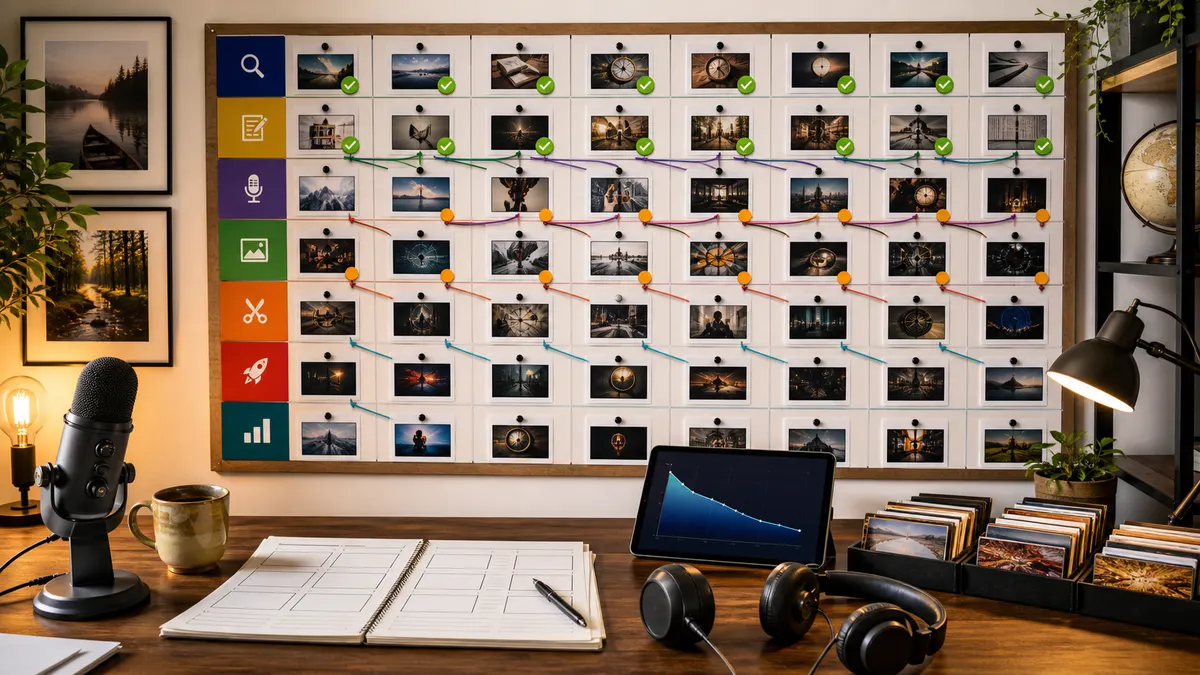
Week 1: strategy and prototypes
Write the channel promise, choose three pillars, collect 30 ideas, and shortlist ten. Produce three prototypes using the same topic in different formats or visual treatments. Do not publish all three automatically. Compare clarity, production time, cost, and how well each treatment expresses the channel. Select one primary short-form format and one optional long-form format.
Week 2: publish the first coherent batch
Create three to five short-form videos from one pillar and, if long-form is part of the strategy, one deeper video. Keep the packaging related enough to signal a series. Publish on a cadence you can maintain after the launch month. Record production time and every correction you make; repeated corrections belong in the template or checklist for the next batch.
Week 3: test hooks, not channel identity
Keep the niche, promise, and visual identity stable. Test different opening structures: consequence, question, demonstration, contradiction, or story moment. Use comments and retention to see which questions viewers actually care about. Do not abandon the channel because one topic underperforms. At this stage you are learning which doors into the same room work best.
Week 4: turn evidence into the next batch
Rank videos by the metric that matched their job. A discovery Short should earn continued viewing and profile or channel interest. A tutorial should earn completion, saves, and search traffic. A long-form story should sustain attention across sections. Choose the top two topic patterns and create follow-ups that go deeper rather than copying the exact title. End the month with the next 30 ideas already organized.
| Month-one output | Minimum useful target | What it teaches |
|---|---|---|
| Channel promise | One sentence | Who the channel serves and why to subscribe |
| Content pillars | Three | How to create variety without losing focus |
| Idea bank | Thirty ideas | Whether the niche has depth |
| Short-form posts | Eight to twelve | Which hooks and topics earn discovery |
| Long-form videos | Zero to three | Whether the niche supports deeper viewing |
| Review sessions | One per week | What to change in the system rather than at random |
Measure what improves the channel
Analytics are useful when they answer a production question. Reach asks whether the platform found an audience. Click-through rate asks whether the packaging earned attention. Early retention asks whether the opening matched the promise. Average percentage viewed asks whether the structure kept progressing. Saves, shares, comments, subscribers, and profile visits ask whether the video created value beyond a passive view.
Compare like with like. A 20-second faceless Reel and a ten-minute YouTube documentary have different jobs. Compare videos inside the same series, format, and duration range. Look for repeated evidence across several uploads before changing the channel identity. One viral outlier can teach you about a hook or topic, but it should not force every future video into imitation.
- Low impressions with strong retention: the content may be good, but the topic or packaging has limited distribution.
- High impressions with low continuation: the first frame or hook did not earn the next moment.
- Strong opening with a middle drop: the script stopped progressing, repeated itself, or changed subject too slowly.
- Strong views with weak follows or subscribers: the individual video worked, but the channel promise is unclear or inconsistent.
- Strong saves and comments with modest reach: the idea may be valuable to a narrower audience and worth developing into a series or long-form resource.
Keep a small scorecard beside the content calendar: topic, pillar, hook type, format, duration, visual style, publish date, reach, continuation, average view duration, completion, saves or shares, and subscribers or follows. Add one sentence about what you think happened. After 20 to 30 posts, patterns become more useful than memory.
Monetization, copyright, and original faceless content
A faceless channel can earn through advertising, affiliate recommendations, sponsors, digital products, memberships, services, licensing, or leads. The right model depends on the audience. A narrow business tutorial channel may earn from software affiliates and consulting before it reaches major ad revenue. An entertainment channel may need scale before sponsors or ads become meaningful. Decide which valuable action the audience could take, but do not make every video a sales pitch.
YouTube's current channel monetization policy requires original, authentic content and says mass-produced or repetitive template content may be ineligible. Recurring intros, formats, and structures can still monetize when the substance differs materially. What fails is the low-value version: scraped articles read aloud, compilations with minimal change, repeated slideshows, or generic AI templates that provide little original narrative, commentary, education, or entertainment.
Faceless does not mean copyright-free. Permission, copyright, and platform monetization rules are separate questions. Use media you created, licensed, generated under suitable terms, or transformed with legitimate commentary and editing. Keep records for music, stock footage, voice rights, and commissioned assets. Do not download another person's viral clips, add captions, and assume a new voiceover makes the collection yours.
For full YouTube advertising revenue eligibility, the standard route currently requires 1,000 subscribers plus either 4,000 valid public watch hours from long-form videos in the previous 12 months or 10 million valid public Shorts views in 90 days. Shorts-feed watch hours do not count toward the 4,000-hour route. Requirements and availability can change, so verify them on the official YouTube Partner Program page rather than relying on an old screenshot.
Common faceless-channel mistakes
Mistake 1: choosing “faceless” as the niche
Faceless describes production, not audience value. Viewers do not subscribe because the creator avoided a camera. They subscribe for useful finance systems, strange stories, clear tutorials, comforting ideas, or funny characters. Lead with the result or experience, not the production method.
Mistake 2: optimizing for volume before identity
Automating ten videos a day magnifies weak choices. First prove that one audience wants one format from you. Then batch research, narration, scene generation, and publishing. Scale a working editorial system, not an empty template.
Mistake 3: treating visuals as decoration
A random city clip under a sentence about customer retention creates motion but not meaning. Storyboard the nouns, actions, comparisons, and emotional turns. When the idea is abstract, use an example, diagram, or concrete metaphor the viewer can understand immediately.
Mistake 4: accepting the first voice and script
Default settings produce default channels. Test voices against the subject. Read the script aloud. Correct pronunciation. Remove filler. Change pace between setup and payoff. The audience may never see you, but it hears the channel's personality in every sentence.
Mistake 5: using one export everywhere
Cross-posting saves time; careless duplication wastes the opportunity. Keep a clean master and produce platform edits with appropriate framing, openings, captions, covers, and CTAs. A faceless Reel should feel like a Reel, not a YouTube video squeezed into a phone.
Mistake 6: changing the niche before enough evidence exists
Early posts are experiments inside the strategy. Change hooks, topics, duration, and examples before replacing the entire channel promise. Give the platform and the audience enough consistent material to understand what the channel is. Thirty coherent pieces teach more than six unrelated attempts.
Frequently asked questions
A faceless channel publishes videos without making the creator's face its main identity. Narration, screen recordings, animation, generated scenes, hands-only demonstrations, charts, or gameplay present the creator's original research and point of view.
Ship your first faceless video today.
Pick your niche. Pick your models. We render. From idea to finished short in under 7 minutes — no camera, no editor.
Keep reading
27 Faceless YouTube Channel Ideas Ranked by RPM in 2026
AI finance explainers pull $18-32 RPM in 2026 while dark history docs average $12-25 — here are the 27 niches worth building a channel around, ranked and scored.
Faceless Reels: The Complete 2026 Instagram Growth Playbook
Trial-testing hooks before you publish takes a faceless Reels account's hit rate from 18% to 64% — here's the exact niche, character, and autopublish setup behind that number.
Faceless YouTube Automation: The Actual 2026 Workflow
Most "faceless automation" guides automate the wrong part, then quietly kill the channel. Here's the 6-stage workflow — and the two things you should never hand off to AI.